September 8, 2026
Poolside Furniture and Design Ideas for Indian Homes
Poolside furniture and design ideas for Indian homes: lounger layouts, clearances, shade, deck heat, and materials that survive chlorine and sun.
Quick answer
A pool deck that works in India is planned in zones: a sun deck of loungers, a shaded lounge, a dining spot if you eat outdoors, and a daybed corner. Keep a clear walkway of roughly 3 to 4 ft along the pool edge, and allow about 3 by 7 ft for each lounger. Choose powder-coated aluminium, grade-A teak, synthetic wicker or rope, with quick-dry foam and solution-dyed fabric. Plan shade before furniture, and use light, textured stone underfoot.
Start with the sun, not the furniture
A floor plan does not show where the sun is at 3 pm in May, which is why so many pool decks end up usable only early and late in the day.
Before choosing a single piece, stand at the pool mid-morning, early afternoon and late afternoon on a clear day. Note which edge takes the hard western sun, where walls throw shade and where the wind comes from. On a villa or farmhouse plot, that usually decides which long side becomes the sun deck and which becomes the shaded side. On a rooftop or terrace pool there is often no natural shade at all, and wind is the bigger variable.
Poolside design ideas: plan the deck in zones
Give each part of the deck one job. You do not need all four zones; a small terrace pool may fit only the first.
Zone 1: the sun deck
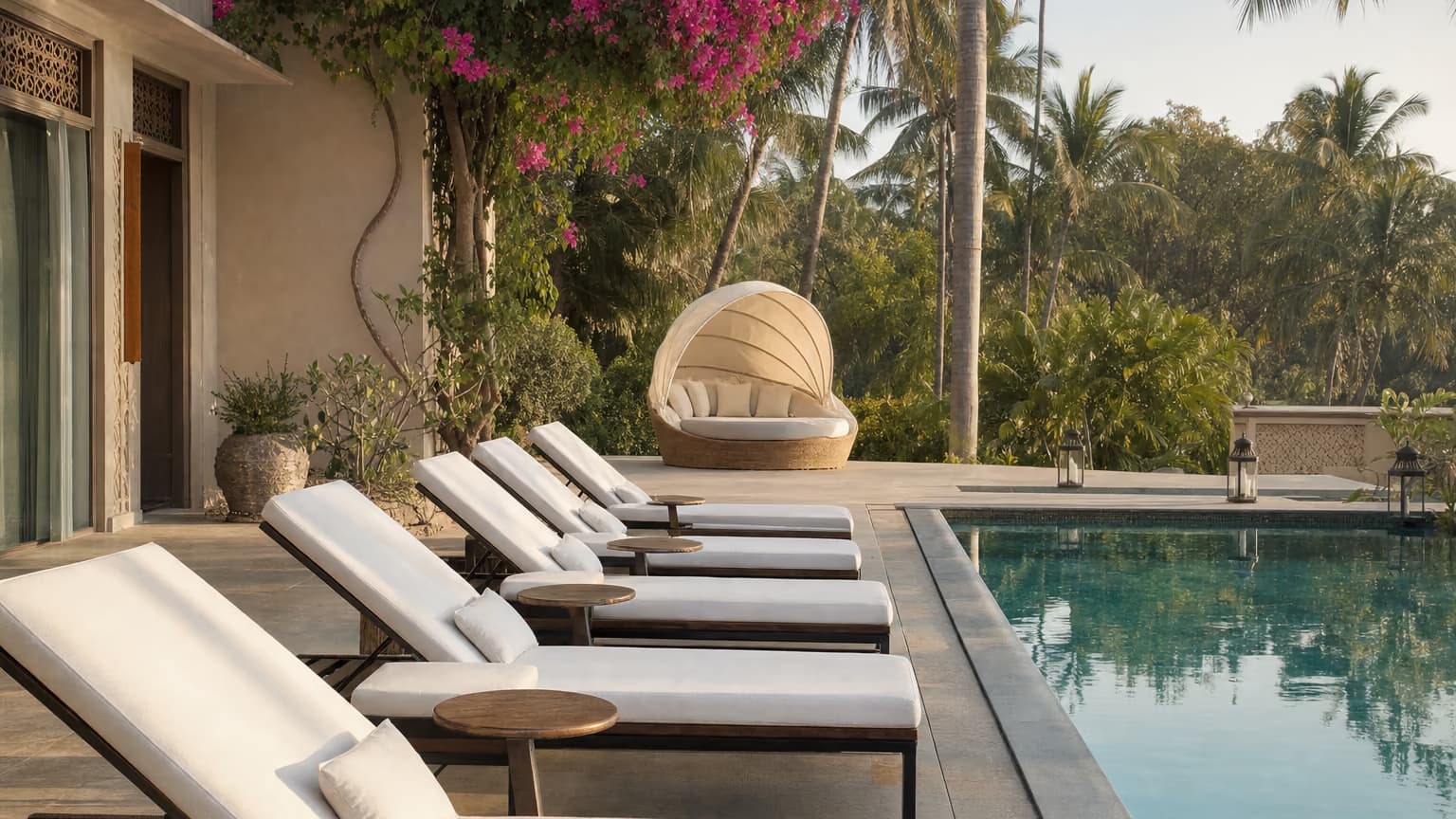
A row of sun loungers along the sunniest edge, parallel to each other, facing the water or the view, with shared side tables for a drink and sunscreen. Keep them back from the edge so the walkway stays clear.
Zone 2: the shaded lounge
Lounge chairs, or a small sofa and chairs, under a pergola, a cantilever umbrella or a tree. This is where people sit between 11 am and 4 pm for most of the Indian year, and where guests who are not swimming end up. Set it a little back from the water so splashes do not reach the cushions.
Zone 3: the dining spot
If you eat by the pool, give the table its own spot on the shaded side, close to the path to the kitchen, rather than squeezing it among the loungers. Our garden sitting area guide covers dining and lounge zone sizing, along with a short poolside note that this guide builds on.
Zone 4: the daybed corner
A round daybed or a double lounger in the quietest corner, in shade for part of the day. It does not need to face the water. It often works better angled towards a garden view or tucked against a planted boundary.
Clearances and circulation around a pool
Space around a pool is about people walking with wet feet and people lying down. Treat these figures as rules of thumb, and check anything structural or safety-related for your site with your architect.
The pool edge walkway. Keep a clear strip of about 3 to 4 ft along the pool edge with nothing on it, and more on the side people enter and leave the water.
The lounger itself. A sun lounger is about 6.5 ft long and roughly 2 to 2.5 ft wide. With room to get on and off, allow about 3 by 7 ft of deck per lounger. A double lounger is wider, so measure the specific piece.
Between and behind loungers. A side table between each pair, or a gap of about 1.5 to 2 ft, lets each person swing their legs off. If people walk behind the row to reach the lounge or the house, leave about 3 ft there too.
Around a round daybed. Leave 2 to 3 ft clear on the sides people climb on from. It can sit closer to a wall or planter on the others.
How many loungers does a pool need?
Fewer than most people buy. Plan for the number of people who sunbathe at the same time on an ordinary day, not the number who come to the party. For most home pools that is two to four, with a double lounger counting as two. When guests arrive, the daybed and the shaded lounge absorb the numbers far better than a long row of loungers that stands empty the rest of the year.
Sun lounger, daybed or lounge chair: which one where
| Piece | Best for | Space needed (rule of thumb) | Notes |
|---|---|---|---|
| Sun lounger (single) | Sunbathing, drying off, reading in the sun | About 3 by 7 ft each, including access | Adjustable backrest matters; keep back from the pool edge |
| Double lounger | Two people sharing, or one spreading out | About 5 by 7 ft, plus access on both sides | Saves width against two singles and a table |
| Round daybed | Napping, lounging together | Roughly 8 by 8 ft with a side table | Best in part shade; approached from one or two sides |
| Lounge chair | Sitting upright, talking, a snack | About 3 by 3 ft per chair, plus walkway | Belongs in the shaded lounge, not the lounger row |
A sun lounger is a long outdoor chair that supports the whole body, with a backrest that adjusts from upright to nearly flat. It is also called a pool lounger, poolside lounger or chaise. You can nap on a lounger comfortably, but for long, lazy rest a daybed does the job better.
Round daybeds and double loungers
Both are pieces for two people, or for one person who wants to lie any way they like. A round daybed reads as a single sculptural object and suits a corner. A double lounger keeps the straight lines of the lounger row and sits well at the end of it. The Arbour round daybed, with its sculpted aluminium frame, or the resort-style Perennial round daybed can anchor the daybed corner, while the Perennial double lounger finishes a sun deck.
An outdoor daybed with a canopy is a popular idea, and the canopy is really a shade decision. A large umbrella or a pergola overhead does the same job, as long as the daybed sits in shade through the hottest hours.
Shade planning for Indian pools
Shade the lounge and the daybed first. The sun deck can stay partly open because some people want the sun. The places people sit for long stretches cannot.
Block the western sun. Late afternoon sun is the harshest and the lowest, and it slides in under umbrellas. A slatted pergola, climbers or a planted screen on the west side does more than an umbrella that is always at the wrong angle.
Choose umbrellas for the site. A cantilever umbrella shades a lounger or daybed without a pole in the middle of it. On rooftops and open farm plots, use a properly weighted base and close umbrellas when you leave the deck.
Use trees carefully. Leaves, flowers and fruit end up in the pool and on the cushions. Choose species that do not shed heavily, and keep them back from the water.
Deck surface heat and wet feet
Stone is the usual pool deck finish in India, and it has a summer problem. Dark stone and polished finishes soak up heat and become uncomfortable barefoot by early afternoon. Lighter stone with a textured or matt finish stays cooler and grips better when wet. On an existing dark deck, a shaded path from the pool to the seating helps a great deal.
Wet feet on smooth surfaces are the main slip risk around any pool. As general guidance, choose a non-slip finish for the surround, keep the edge walkway clear, and avoid rugs that slide on wet stone. Keep glass off the pool deck, including drinkware, glass-topped tables and lanterns. Broken glass near a pool is hard to find and easy to step on.
Materials that survive pool water and sun
By a pool, furniture also takes chlorinated splash and wet bodies several times a day. Our waterproof outdoor furniture guide explains how good pieces manage water rather than block it, and the teak, aluminium and wicker material guide compares frames in depth.
Powder-coated aluminium. Aluminium contains no iron, so it does not rust, and a sound powder coating handles pool splash well. The weak point is a chip in the coating, where chlorinated or salty water can attack bare metal over time. Touch up deep scratches, and ask what the fasteners are made of, since hardware is often the first thing to show corrosion near a pool.
Grade-A teak. Its natural oils and dense grain let it take repeated wetting without swelling or rotting. Sun is what turns it from honey to silver-grey, and constant splash can speed that along, so oil it more often if you want to keep the colour.
Synthetic wicker and handwoven rope. Water drains straight through the weave, so a seat dries quickly after someone sits on it wet.
Quick-dry foam and solution-dyed fabric. Open-cell foam lets water run through rather than holding it in the core. Solution-dyed fabric carries its colour through the fibre, so it resists sun fading and chlorine bleaching far better than surface-dyed fabric. Fading still happens over years; it is slower, not absent.
Saltwater pools. These generate chlorine from salt, so the splash carries salt too. Rinse frames and fittings with fresh water more often, as you would in a coastal home.
Cushion care by the pool
Pool water is rarely what ruins poolside cushions. Sunscreen, body oil and wet swimsuits do more damage, leaving yellowish marks that set in the sun.
- Keep a towel on the lounger when you come straight from the water or wear sunscreen.
- Rinse cushions with fresh water every week or two in swimming season, and stand them on edge to drain.
- Clean sunscreen marks early with mild soap, and check the fabric's care instructions before using anything stronger.
- Store cushions in a ventilated box when you are away, or once the monsoon settles in and the pool is rarely used.
Our maintenance and care guide covers seasonal care in more detail.
Rooftop and terrace pools
Wind is stronger up high, so light cushions blow into the water and lightweight loungers can shift. Choose pieces with enough weight to stay put and keep loose items to a minimum. Space is tighter, so the zones compress to a pair of loungers and one lounge group, and a double lounger saves width. Heavy planters, pergolas and furniture add load to the slab, so check the plan with your structural engineer.
The same zone thinking applies at a larger scale to hotel and resort pools, and we have furnished hotels as well as homes.
Lighting the deck after dark
Low, warm lights along the edge walkway and steps matter most, because they show where the water ends. Softer light in the lounge and daybed zones sets the mood without glare off the water. As general guidance, use outdoor fittings rated for wet areas, installed by a qualified electrician, and keep extension cords and speakers well back from the edge.
Choosing your loungers
The Laurel sun lounger has a modern frame, the Perennial single lounger comes from the same resort-style collection as the Perennial daybed and double lounger, and the Canyon lounger brings strong geometry and natural textures. Pick lounge chairs from the same collection so the deck reads as one design. Pricing depends on dimensions, materials and configuration, and our outdoor furniture price guide explains what drives it.
Final Thought
A good pool deck is mostly decided before any furniture arrives. Where the sun falls in the afternoon, where people walk with wet feet, and where they want to lie down for an hour decide the layout. The furniture then fills zones that already make sense.
Get the shade and the walkway right, keep the lounger count honest, and choose materials that shrug off splash and sun. A deck planned that way gets used through the year, not just in the few mild weeks when anything would do.
Every piece we build is made to order in our Noida workshop, in powder-coated aluminium, grade-A teak, handwoven rope and synthetic wicker, with quick-dry foam and UV-resistant fabrics, and sized to your deck. Allow 4 to 8 weeks from order confirmation, and we deliver and install across India. Browse the collections to see the loungers and daybeds, message us on WhatsApp with your pool deck dimensions and a few photos, or book an appointment to visit the design studio in Noida.
Frequently Asked Questions
A sun lounger is a long outdoor chair that supports the whole body, usually with a backrest that adjusts from upright to nearly flat. It is designed for lying in the sun, which is where the name comes from, and is also called a pool lounger, poolside lounger or chaise. By Indian pools it is used just as often for drying off, reading and resting in the shade.
The best sun loungers are defined by specification rather than name. Look for a frame in powder-coated aluminium or grade-A teak, a woven or slatted seat that drains quickly, and an adjustable backrest with several positions. Cushions should use quick-dry foam and solution-dyed fabric. On rooftops, choose a lounger with enough weight to stay put in wind, and check the warranty treats the frame and cushions separately.
Yes, for a nap. A lounger reclined nearly flat with a good cushion is comfortable for an hour or two, ideally in shade rather than midday sun. Sleeping outdoors overnight on one is less practical, because dew dampens the cushion, mosquitoes arrive after dark and a single lounger is narrow for a full night. For long rest outdoors, a round daybed or a double lounger is the better piece.
In British usage, a sun lounge can also mean a glazed room built to catch sunlight, similar to a sunroom. As outdoor furniture, a sun lounge or sun lounger is used for lying in the sun, drying off after a swim, reading and napping by a pool or in a garden. In Indian homes it is most often placed on a pool deck or an open terrace.
Plan for the number of people who sunbathe at the same time on an ordinary day, which for most home pools is two to four. A pair suits a couple or a small terrace plunge pool, and four suits a family, with a double lounger counting as two. When guests come, a daybed and a shaded lounge group handle the extra people far better than extra loungers.
For frames, powder-coated aluminium is the most reliable choice because it does not rust, and grade-A teak handles repeated wetting well, though it greys faster in full sun unless oiled. Synthetic wicker and handwoven rope drain quickly after someone sits on them wet. For cushions, quick-dry foam with solution-dyed fabric is the right combination, since it drains fast and resists fading and chlorine bleaching.