November 13, 2026
Terrace Garden Design Ideas: Planting and Seating
Terrace garden design for Indian homes: plan where you sit and eat first, then place planters, water lines and shade around that zone.
Quick answer
Good terrace garden design starts with where people will sit, not with the plants. Fix the seating or dining zone first in the spot with the best shade and access, keep a clear path from the door, and give the planting the edges: containers along the parapets, with heavier planters only where a structural engineer confirms the slab can take them. Run water lines behind the planters, keep wet soil away from cushions, and choose furniture that copes with splash, soil and sun.
Plan the living zone before buying plants or furniture
A terrace garden gets used when it has one clear place to sit and one clear way to reach it. Plants fill the space that is left, not the other way round.
Work in this order.
1. The living zone. Decide if the terrace is mainly for sitting, eating or both, and put that zone in shade at the hours you use it, close to the door. Seating wants the shadiest spot and plants the sunniest, so they rarely compete.
2. The main path. As a rule of thumb, keep about 3 ft clear from the door to the living zone, the drain outlets and the water tap.
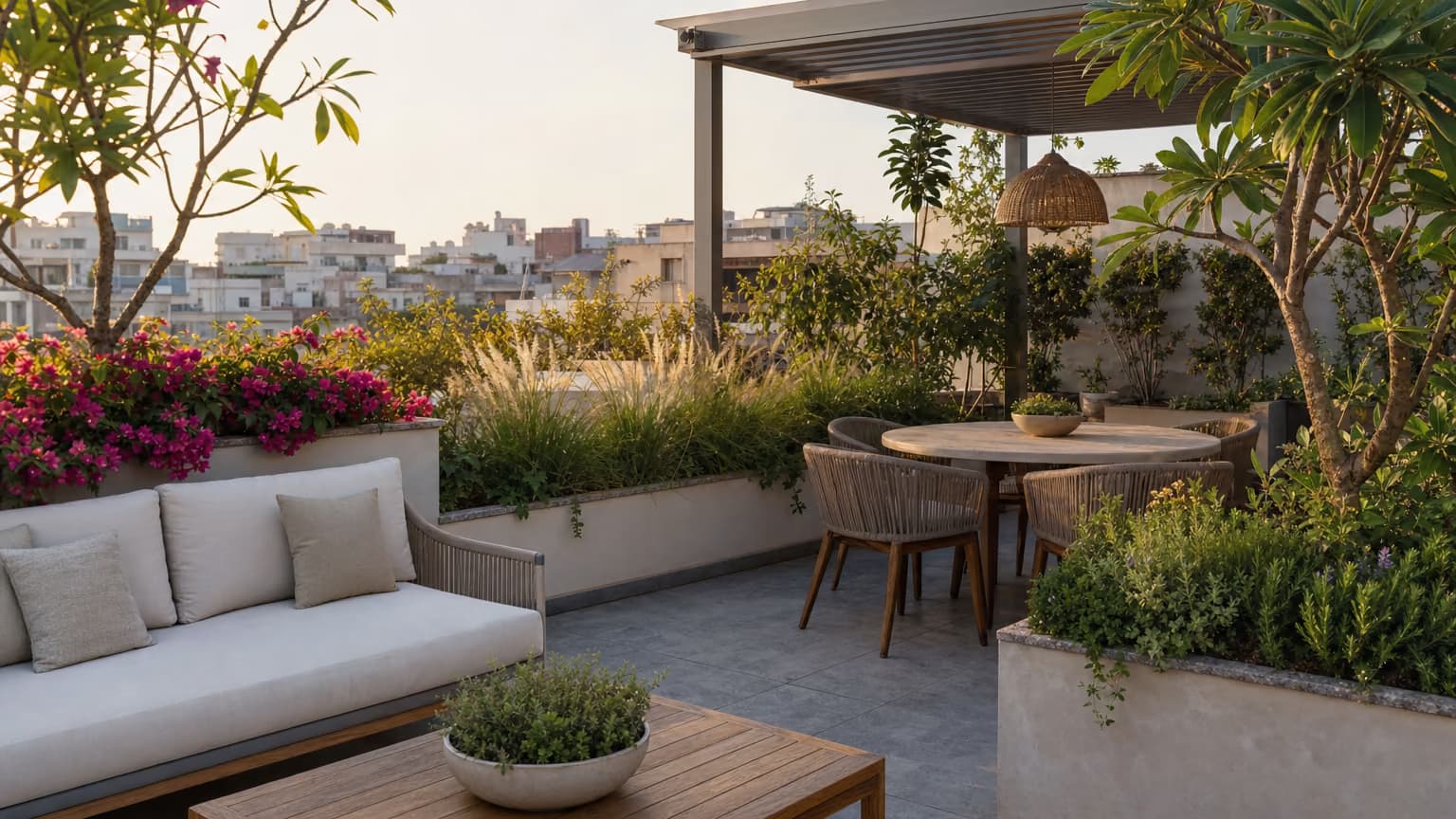
3. The planting. Give the plants the parapets, the corners and any sunny strip the seating does not need. A row of planters can also divide two zones, such as a lounge and a dining table.
4. The service corner. Keep the tap, hose, potting mix and spare pots in one corner near the water point, out of sight of the seating.
Our terrace design ideas guide covers whole-terrace planning, including flooring, lighting and privacy. This post covers how planting and furniture share the same floor.
Terrace garden layouts for small, medium and large terraces
The size bands below are working bands for this post only, since there is no standard terrace size in India. Measure the clear usable area, leaving out the stair head room, water tanks and anything else fixed to the roof.
| Terrace (working band) | Living zone | Planting | What works |
|---|---|---|---|
| Small, up to about 150 sq ft | Two chairs and a side table, or a small table for two | One line of containers along one or two parapets | One use only. Let the plants frame the seat, not surround it |
| Medium, about 150 to 400 sq ft | A four-seat lounge group (about 10 by 10 ft) or a dining table for four | Containers along two or three parapets, a few larger planters in the sunniest corner | Plants on the sunny side, seating on the shaded side, a planter row as a soft edge between them |
| Large, over about 400 sq ft | A lounge group and a separate dining zone | Edge planting, a planter group or raised bed between the zones, creepers on a shade structure | A 3 ft route linking door, lounge, dining and garden, with a daybed or single seat among the plants |
To size the planting, draw the living zone and main path on your sketch first, using real furniture dimensions. The floor left along the edges is your planting area: perhaps one strip about 18 inches to 2 ft deep on a small terrace, most of the perimeter on a large one.
For seating layouts by terrace shape and how much space each group needs, see our terrace sitting area ideas.
Containers, raised beds and slab load
On an existing roof, grow in containers and raised planters rather than laying soil on the slab. Containers keep roots and constant moisture off the waterproofing and can be moved when the roof needs repair.
Where heavy planters go. Wet soil is very heavy, and a large planter after watering or a monsoon shower weighs far more than it looks. Heavy planters are usually better placed along the parapets and over beams and columns than in the middle of a slab. Do not assume this on your own roof. Before adding large planters, raised beds or a cluster of heavy pots, check with a structural engineer what your slab can carry and where.
Raised beds. A built bed concentrates a lot of soil in one place, so include it in the engineer's check, line it and give it outlets to the roof drains. Built at about 18 inches high, close to normal seat height, its edge can double as a perch. A potting mix with cocopeat and perlite weighs less than garden soil, but it does not replace the engineer's check.
Keep the parapet safe. Never stand planters on top of the parapet wall, where they can fall onto people below. Keep tall planters and benches away from the inside face of a low parapet, where children could use them as a step.
Raise every pot. Stand containers on feet or low stands so water runs underneath and the floor can dry.
Water, drainage and keeping furniture dry
Keep water lines, run-off and wet soil on the planting side of the terrace, and leave a dry gap around the seating.
Run lines behind the plants. Run any drip irrigation line along the parapet behind the planters, never across the floor where people walk. A timer at the tap can water early in the morning, before anyone sits out.
Leave a gap. As a rule of thumb, keep about 18 inches between a planter and any cushioned seat, so you can water and prune without moving chairs or splashing fabric.
Keep the drains clear. Every planter needs a drainage hole, and its water needs a route to the roof outlets. Soil and leaves wash towards the lowest point, which is where the drain sits. Keep planters and furniture off the outlets, keep seating out of the run-off route, and clear the outlets before the monsoon.
Empty the saucers. Saucers under pots hold standing water, which breeds mosquitoes. Empty them after watering and through the rains.
Shade for a garden terrace
Put the shade over the living zone and leave the planting open, unless your plants need protection from summer sun. Our terrace design guide compares pergolas, awnings, shade sails and umbrellas.
Two points matter on a garden terrace. Creepers on a pergola need planters at the base of the posts, which adds weight at exactly those points, so include them in the engineer's check. And a shade net on a light frame is a common, low-cost way to protect plants through May and June. We do not make shade structures; we make the furniture that goes underneath.
Choosing seating and dining for a terrace garden
Choose furniture last, sized to the living zone you have marked, with the gap to the planters already in the plan.
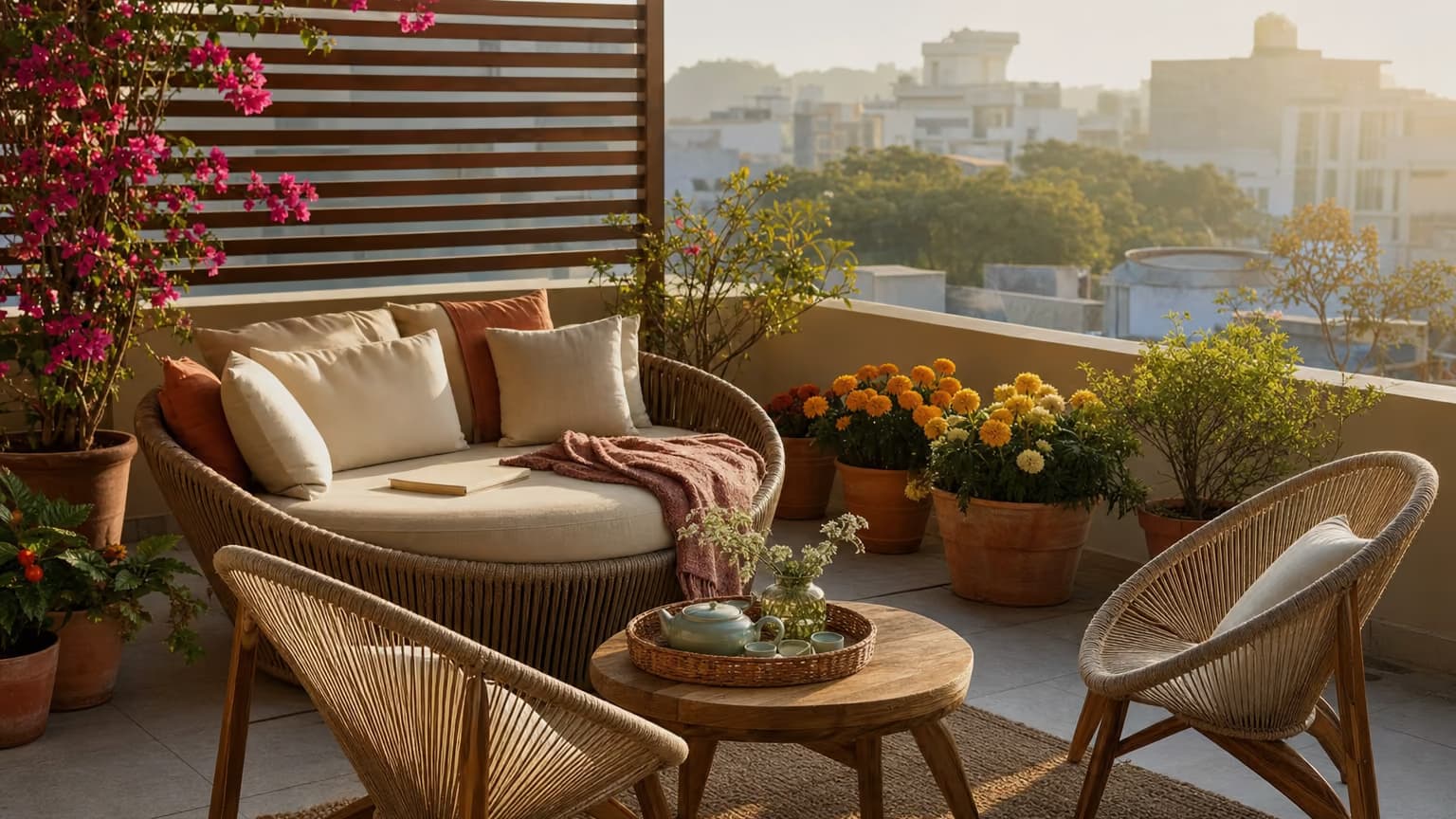
Sitting. A sofa or a pair of lounge chairs with a low table suits evening tea. A daybed or a single lounge chair placed among the plants gives the garden part of the terrace a reason to be used.
Eating. Put the dining table near the door to the kitchen or stairs, with the herb pots close by. Allow about 3 ft from the table edge to the nearest planter or wall so chairs can pull out, and size the table for the number you seat most weeks. Our outdoor dining set buying guide covers table shapes and seat counts.
Two or three well-proportioned pieces look calmer among plants than many small ones. Planters often take a strip off one side of the floor, and furniture made to order can be sized to the space that is left, including narrow and L-shaped areas.
Materials that cope with soil, splash and sun
Choose rust-proof frames, weaves that rinse clean and cushions that dry fast, because garden terrace furniture is splashed daily and sits in strong sun.
- Powder-coated aluminium does not rust, so watering splash does not harm the frame, and soil wipes off.
- Grade-A teak handles damp and sun well and looks natural among plants. Left untreated, it weathers to a silver-grey.
- Synthetic wicker and handwoven rope cope with splash, but soil can settle in the weave, so rinse them with plain water now and then.
- Cushions with quick-dry foam and UV-resistant, solution-dyed performance fabric dry faster and hold their colour longer. Still bring them in or cover them when the terrace is not in use, and before you water.
Our maintenance and care guide explains how to clean each material.
Low-maintenance planting that suits a sitting area
Near the seating, choose plants that stay tidy and do not fight the furniture. Keep thorny plants such as bougainvillea away from seats and paths, where they snag fabric. Avoid plants that drop sticky flowers or berries over cushions. Put herbs and scented plants near the dining table, and hardy shrubs and grasses in the larger planters along the sunny parapets. Fewer, larger containers are easier to water than many small pots.
When to set up a terrace garden in North India
In Delhi, Noida, Gurgaon and across the north, October to March is the main gardening season. Plants establish well and the terrace is pleasant to sit on, so autumn is a good time to plan.
If you are ordering furniture for the season, settle the layout first. Standard orders take about 8 weeks, custom designs can take longer, and the team confirms the timeline for each order. Before the monsoon, check that the drains are clear and no planter blocks the run-off. Our Delhi and Gurgaon pages cover how the northern climate shapes furniture choices.
Final Thought
The terrace garden that gets used every day is not the one with the most plants. It is the one where somebody decided first where people would sit, kept a clear path to that spot, and let the planting grow around it.
Before buying a single pot or chair, sketch the terrace, mark the shade, drains and tap, and place the living zone. Check planter weight with a structural engineer. Everything else gets easier once that sketch exists.
Every piece we make is made to order in our own workshop in Noida, built to the dimensions of your terrace, and we deliver across India. Every piece carries a five-year structural warranty covering the frame in aluminium or teak, the weave construction, and hardware and fittings; cushions carry a one-year warranty covering fabric defects, foam compression and stitching. Normal wear, UV fading and improper care are not covered. Design consultation is available on request. You can browse our outdoor furniture collections, message us on WhatsApp with your terrace sketch and a few photos, or book an appointment to visit the design studio in Noida.
Frequently Asked Questions
Sketch the terrace with the door, drains, water tap and where the sun falls. Mark where you want to sit or eat, then a clear path to it, and use the edges for planting. Begin with a few containers on raised feet along the parapets. Before adding large planters or raised beds, ask a structural engineer what the slab can carry.
Place the living zone first, in the spot with the best shade and closest to the door. Keep a main path of about 3 feet from the door to that zone and to the drains. Put planters along the parapets and in the sunniest corners, with roughly 18 inches between planters and any cushioned seat. On a larger terrace, a row of planters can divide a lounge from a dining area.
Planters add weight to the slab, constant moisture can find weak spots in the waterproofing, and soil and leaves can block the drains. Day to day, watering splashes furniture and soil collects in cushions when planters sit too close to the seating. An engineer's check, raised containers and a clear gap around the furniture avoid most of these problems.
There is no single best plant. On an open Indian terrace, hardy shrubs, ornamental grasses and herbs usually cope best with strong sun and wind. Near the seating, choose plants that stay tidy and have no thorns, and avoid ones that drop sticky flowers or berries on cushions. Fewer, larger containers hold moisture longer and are easier to water than many small pots.
A shade net stretched over a simple frame is usually the lowest-cost way to cover part of a terrace, and it also protects plants in peak summer. A large umbrella on a heavy base can shade a seating area. Anything fixed to the slab or parapet should be checked for waterproofing and wind load first, and in apartment buildings ask the society before installing it.
On a very small terrace, choose one use and keep the floor open. Two chairs and a side table, or a small table for two near the door, work better than a crowded set. Line one or two parapets with containers on raised feet and keep the walkway clear. A raised planter at about seat height can double as extra seating, and furniture built to exact dimensions helps in tight corners.