November 20, 2026
Outdoor Cafe Design in India: Seating and Furniture
Outdoor cafe design for Indian garden, courtyard and pavement cafes: covers per area, aisle widths, furniture that lasts and weather planning.
Quick answer
Good outdoor cafe design starts with the layout, not the look. As a rule of thumb, allow about 12 to 15 sq ft per guest for compact two-seaters, 16 to 20 sq ft for four-seat dining and 25 to 35 sq ft for lounge seating. Keep a main service path at least 3 ft wide. Use square two-seaters that push together for groups. Choose rust-proof frames, wipe-clean tabletops and quick-dry cushions, then plan shade, lighting and nightly storage before you order.
What does an outdoor cafe area have to do?
An outdoor seating area has to earn its space every day. It must be comfortable enough that guests order a second coffee, quick to clean and reset between sittings, and tough enough for sun, rain and dust.
This guide is for ground-level cafes and restaurants: a garden, a courtyard, a front lawn or a strip of pavement outside the door. If your seating is on the top floor, read our rooftop restaurant design guide instead, because wind, slab load and lift access change the furniture choices.
Ground-level seating has its own problems. Floors are uneven, lawns go soft after rain, leaves fall and passers-by need room to walk. Most of this is solved in the layout.
How do you plan an outdoor cafe layout?
Plan the layout by working out how many covers the space takes, then drawing the service route from the kitchen door to the farthest table.
Measure the space and mark the service door, the street entry, drains, trees, steps and power points. Most cafes do well with mostly two-seaters, a few four-seat tables and, if space allows, one lounge corner.
The figures below allow for the table, about 18 inches behind each chair so it can pull out, and a share of the gap to the next table.
| Seating type | Typical setup | Area per guest (rule of thumb) | Where it fits |
|---|---|---|---|
| Compact cafe | Two-seater tables about 2 ft to 2 ft 6 inches square, armless chairs | About 12 to 15 sq ft | Pavement strips, small courtyards, quick coffee service |
| Standard dining | Four-seater tables about 3 ft square or 3 ft round, chairs with arms | About 16 to 20 sq ft | Garden dining, brunch and dinner service |
| Lounge | Sofa, lounge chairs, coffee table and side tables | About 25 to 35 sq ft | One shaded corner, longer evening stays |
| Ledge or counter | Bar chairs at a ledge, about 2 ft of ledge per seat | About 10 to 12 sq ft, with a passage behind | Along a wall, railing or window |
As a worked example, a 20 ft by 20 ft courtyard is 400 sq ft. At compact density that is roughly 26 to 33 guests on paper. With a clear path from the door, expect the lower end.
Aisles and table spacing
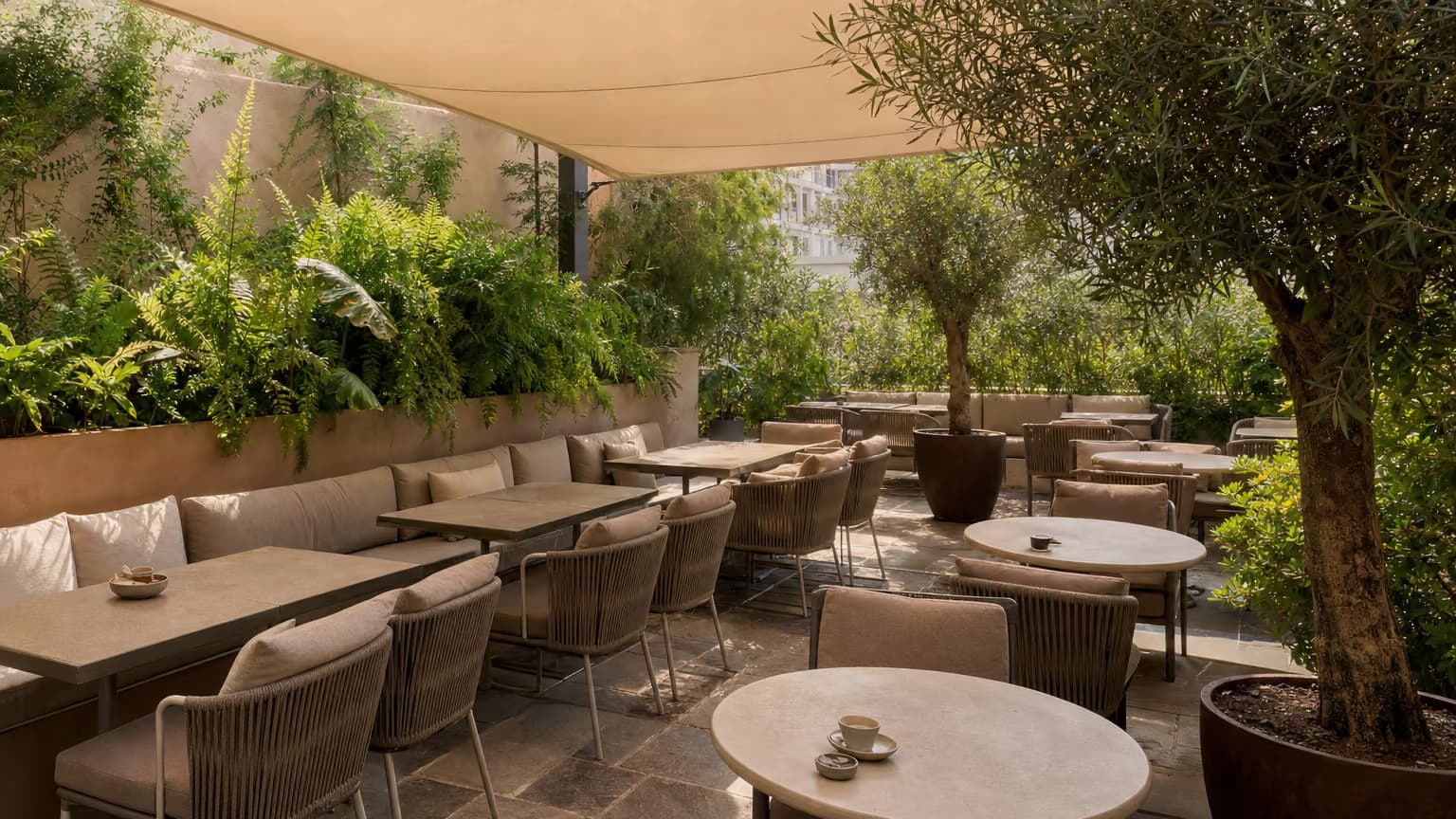
As a rule of thumb, keep the main service path at least 3 ft wide, and nearer 4 ft where trays pass in both directions or near the kitchen door. Where two tables sit with chairs back to back, allow about 4 to 5 ft between the table edges so guests can sit and a server can still pass.
Two-seaters that push together
Square tables of the same size and height can be joined for a group: two 2 ft 6 inch two-seaters make a table for four, and three make one for six. Round tables look softer but do not join.
Garden, courtyard and pavement: what changes
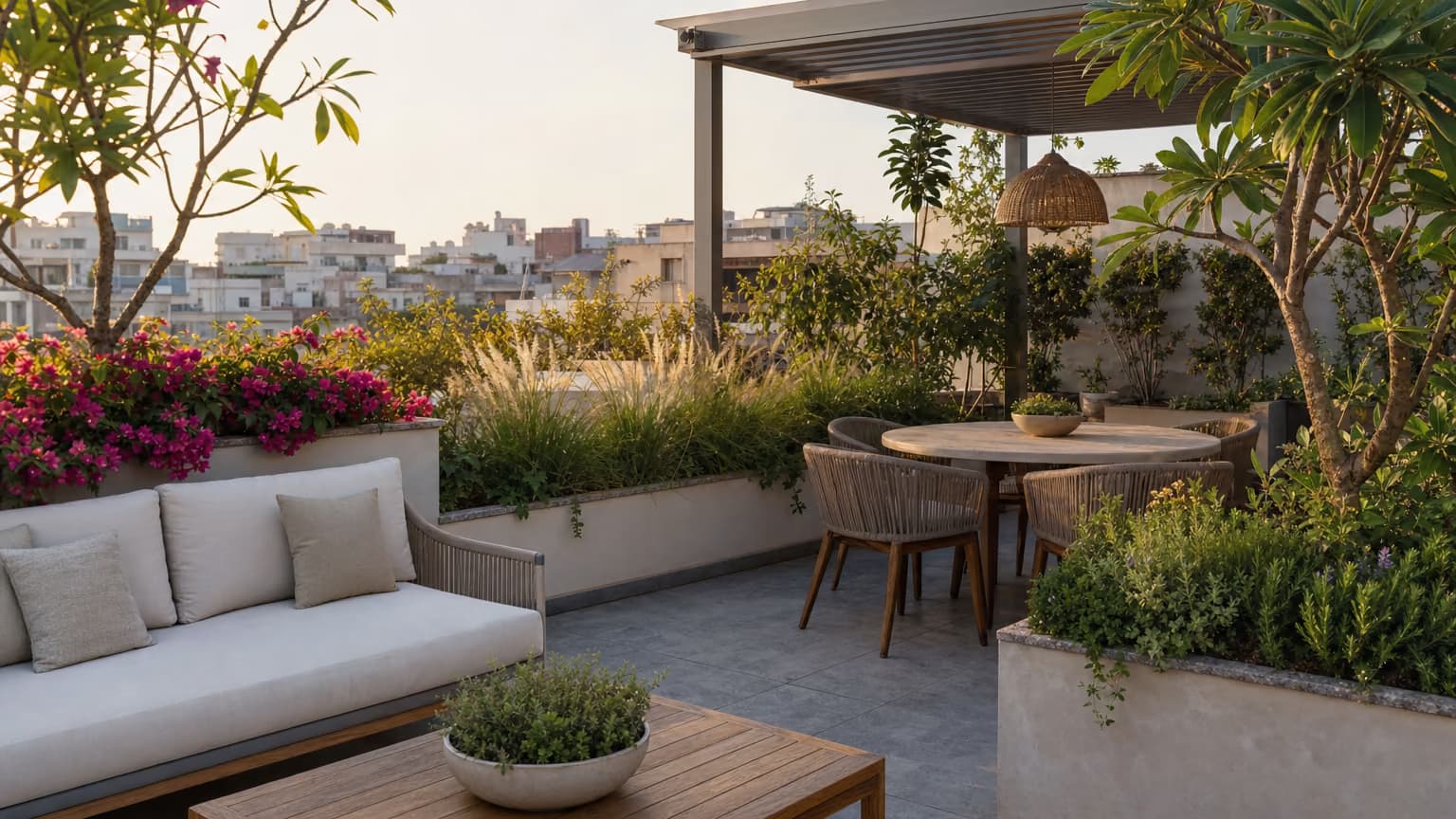
Lawn. Chair legs sink into wet grass and tables rock. Put dining tables on paved pads, stepping stones or deck tiles, and keep the lawn for lounge seating and planters.
Courtyard, paving and gravel. Old paving is uneven, so ask for adjustable feet on table bases and glides on chair legs. Chair legs dig into gravel, so keep it to the edges.
Pavement. Keep a clear walking strip for pedestrians, and check local rules on outdoor seating and licences before you plan the layout, because they vary by city and by road.
Which dining chairs and tables suit daily cafe service?
The right dining chairs and tables stay comfortable through a full meal and are quick for staff to wipe down and reset. Our outdoor dining set buying guide covers table shapes and seating counts.
Chairs. The usual pairing is a table 29 to 30 inches high with a seat 17 to 18 inches off the ground, as a rule of thumb. Armless chairs about 18 to 20 inches wide pack tighter; armchairs need about 22 to 24 inches and are more comfortable for long brunches. Seats in rope, slats or weave let rainwater through. The Perennial dining chair is one design to look at.
Storage. At ground level, chairs often come in at night. Stackable chairs save space; if yours do not stack, measure the storeroom and count how many fit before you order.
Tabletops. Pick a top that wipes clean, does not hold water and copes with hot cups. Compact laminate and sintered stone hold up well in commercial use; teak looks warm but needs oiling.
Should an outdoor cafe have a lounge corner?
Yes, if the space allows one. A lounge corner gives guests a reason to stay longer and order again.
Keep it to one corner with the best shade or view, because lounge seating takes roughly twice the space per guest of dining. A sofa or L-sectional with two lounge chairs and a coffee table seats a small group. Set the coffee table 14 to 18 inches in front of the sofa, put a side table beside each lounge chair, and keep an ottoman or two for when a bigger group turns up.
Where do bar chairs work in an outdoor cafe?
Bar chairs work along a ledge facing a wall, a railing or the street, where a table would block the path.
Match the seat to the ledge. As a rule of thumb, a counter-height ledge of about 36 inches needs seats around 24 to 26 inches high, and a bar-height ledge of 40 to 42 inches needs seats around 28 to 30 inches. That leaves 10 to 12 inches of knee room. For drinks only, 12 inches of depth is enough; plates need 16 to 18. A built-in ledge or counter is a masonry or carpentry job, so build it first and order bar chairs to match.
What is the best material for outdoor cafe furniture in India?
For most outdoor cafes in India, powder-coated aluminium frames are the safest base. They do not rust, are light enough to move daily, and carry synthetic wicker or outdoor rope seats. Keep grade-A teak for one or two feature pieces, say a long communal table. Avoid mild steel, which rusts at scratches, and indoor wood or cane, which swell and rot in the monsoon.
For cushions, ask for quick-dry foam inside UV-resistant, solution-dyed fabric, with zipped covers that come off for washing. For a closer look at each frame, see our teak, aluminium and wicker material guide.
How do you plan for sun, monsoon, dust and winter evenings?
Plan for the weather your city actually has, season by season.
Sun. Shade decides whether outdoor tables fill at lunch from March to June. Umbrellas on heavy bases suit flexible layouts; an awning or pergola suits seating that stays in one place.
Monsoon. In Mumbai, Goa, Kochi and along the coast, rain decides everything from June to September. Bring cushions in, keep drains clear and plan a covered section if you stay open outdoors. For rainy-season care, see our monsoon-proof outdoor furniture guide.
Dust. In Delhi, Jaipur and much of the north, dust settles daily. Smooth frames and tabletops wipe down faster than deep weaves.
Winter evenings. Winter is the outdoor season in the north, but December and January evenings are cold enough to need heat. Outdoor heaters need clear space from umbrellas, awnings and fabric, so follow the maker's instructions.
Lighting. Layer path lights, table lights and soft light in planters. As a rule of thumb, use fittings rated IP65 or higher where rain reaches them, and have a licensed electrician run the outdoor circuit.
Low budget outdoor cafe design: where to save and where to spend
On a low budget, spend on what takes daily wear and weather, and save on what you can change each season.
Spend on: the chairs, since every guest uses one at every sitting; proper outdoor fabric and quick-dry foam; shade over the tables that fill first; and tabletops that shrug off stains and water.
Save on: planters, lanterns and string lights; plain light fittings, as long as they are rated for outdoor use; one modest lounge corner rather than sofas throughout; and a short list of chair designs in a single finish instead of one big matching set.
Working with a manufacturer on a cafe order
Made-to-order furniture is sized to your courtyard, not the other way round. Send a measured plan, the covers you want, site photographs, the height of any ledge, where furniture goes at night, and your opening date. Ask which materials suit each zone, how heavy each piece is, and how the warranty applies to daily commercial use.
World of Outdoors has furnished restaurants and hotels. Every piece is made to order in our own workshop in Noida, in powder-coated aluminium, grade-A teak, handwoven rope and synthetic wicker, built to the dimensions you need. Production takes about 8 weeks as standard, custom designs can take longer, and the team confirms the timeline for each order. Minimum order requirements vary by piece and project, and customers can discuss them with the team. Design consultation is available on request for a small cost. We deliver across India and arrange installation where specialised installation is needed.
Final Thought
A busy outdoor cafe rests on a few plain decisions made early, such as the number of covers, the line of the service path and where the chairs go at night. Get those right and most styles will work.
Draw the plan, mark the drains and the shade, and count your covers before you look at styles. Once that is on paper, choosing the furniture is the easy part.
Every piece we make is made to order in our own workshop in Noida and sized to your cafe. Browse our outdoor furniture collections to see the range, message us on WhatsApp with a floor plan and photos of the space, or book an appointment to visit the design studio in Noida.
Frequently Asked Questions
As a rule of thumb, allow about 12 to 15 sq ft per guest for compact two-seat tables, about 16 to 20 sq ft for four-seat dining with armchairs, and about 25 to 35 sq ft for lounge seating with sofas and coffee tables. These include room to pull chairs out and a share of the gap to the next table, so leave extra for a main service path at least 3 ft wide.
For most restaurants and cafes in India, chairs and table bases on powder-coated aluminium frames are the most practical choice, because they do not rust and are light enough to move daily. Synthetic wicker or outdoor rope seats add comfort and drain after rain. Use teak for a few feature pieces. Tabletops should wipe clean and resist heat, and cushions need quick-dry foam and UV-resistant fabric.
Start with a measured layout and fit mostly two-seat square tables that can be pushed together for groups. Spend first on durable chair frames, outdoor-grade fabric and shade over the tables that fill first. Keep decor, light fittings and the lounge corner modest. A small range of chair designs in one finish still looks planned and keeps the order simple.
Frames in powder-coated aluminium or teak, and seats in synthetic wicker or outdoor rope, can stay out in the rain. Cushions are better brought in during heavy rain and at night, even with quick-dry foam, so they dry properly and last longer. Wipe frames down after storms, keep drains clear of furniture and avoid mild steel or indoor wood anywhere exposed.
Build the outdoor area around what the site already has, such as a large tree, an old courtyard wall or a street view. Use one strong idea, perhaps a lounge corner under a pergola or a long ledge with bar chairs. Keep one colour palette across chairs, cushions and planters, and use warm, layered lighting for the evenings.
Restaurants usually buy furniture from contract furniture suppliers, made-to-order manufacturers or ready-made retail ranges. Ready-made pieces are quicker to get but come in fixed sizes. Made-to-order makers build to the dimensions and finishes of the space and can match seat heights to existing counters, but production takes longer. Ask any supplier how the warranty applies to daily commercial use before you order.