August 11, 2026
Waterproof Outdoor Furniture in India: What the Claim Actually Means
Waterproof outdoor furniture in India: what the claim really means, which materials hold up in rain, and what to get in writing before you pay.
Quick answer
Almost no outdoor furniture is truly waterproof, and the parts that come closest are the frames, not the cushions. Waterproof means water cannot pass through at all, water-resistant means it is held off for a while, and weatherproof means the whole piece is built to live through rain, sun and humidity without failing. The frames that handle Indian rain are powder-coated aluminium, grade-A teak, and synthetic wicker or handwoven rope over an aluminium frame. Good cushions work differently: quick-dry open-cell foam and UV-resistant solution-dyed fabric, so they drain fast rather than keeping water out. Mild steel, natural cane, ordinary foam and engineered wood fail whatever the listing says. Before you pay, ask for the named material grades on the quote and a written warranty that treats the frame and the cushions separately.
Three words sellers use, and what each one actually promises
Search for waterproof outdoor furniture in India and you will see the same three words across every listing, used as if they mean the same thing. They do not, and the gap between them is where most disappointing purchases happen.
Waterproof is the strongest claim. Water cannot get through the material at all, in either direction. A powder-coated aluminium tube is waterproof. A sheet of HDPE is waterproof. A cushion is not, and no amount of marketing changes that.
Water-resistant means water is repelled for a period, under some conditions, and then it is not. A fabric with a surface finish sheds a light shower and soaks through in a downpour. That treatment wears off with washing and sun, so a water-resistant piece is water-resistant on the day it arrives and less so every year after.
Weatherproof or all-weather is the broadest of the three and the one that matters to you. It says the piece as a whole is built to sit outdoors through rain, heat, humidity and UV without rusting, rotting, warping or falling apart. A weatherproof set can contain parts that are waterproof, parts that are only water-resistant, and parts that are neither but drain quickly. That combination is the point, not a compromise.
So when a listing simply says waterproof, the useful question is not whether the word is true. It is: waterproof which part, and for how long.
Can outdoor furniture truly be waterproof?
Honestly, a whole set never is. Individual components can be.
Think about what a chair is made of. A frame, joints and fasteners, a weave or seat surface, and on most pieces a cushion. Aluminium tube is impervious to water, and so is the powder coating over it. But the hollow inside that tube is not sealed off from the world, which is why well-made frames have drainage holes in the feet so any water that gets in runs back out. No joint stays perfectly sealed forever. And the cushion on top is a foam block wrapped in fabric, which is a sponge with a jacket.
So the honest answer is that outdoor furniture is designed to manage water rather than block it. The frame refuses to absorb or corrode, the weave lets water pass through instead of holding it, the foam drains and the fabric dries. Nothing traps moisture where it can sit and do damage.
A set built that way takes monsoon after monsoon without complaint. A set marketed as waterproof but built with a mild steel frame and a closed foam cushion looks identical in a photograph and is finished in two seasons. If your worry is getting through the rains with what you already own, our monsoon care and survival guide covers that side of it. This guide is about what to look for before you buy.
The frame and the cushions are two separate promises
This is the single most useful idea to carry into a quotation, and almost nobody explains it.
A frame is a structural promise. It either corrodes or it does not, it either holds its joints or it does not, and that is settled by the metal, the wood and the hardware. A good frame is a ten-year proposition and should be sold to you as one.
A cushion is a comfort promise, and comfort materials wear. Foam compresses, fabric fades, stitching takes the sun. Even the best outdoor cushion is a consumable in a way an aluminium frame is not.
You can see the difference in how the two are warranted. At World of Outdoors the structural warranty runs five years and covers the frame in aluminium or teak, the weave construction, and the hardware and fittings. The cushion warranty runs one year and covers fabric defects, foam compression and stitching. Normal wear, UV fading and improper care are not covered, on either. That split is not small print, it is the accurate shape of the product, and any warranty you are offered should be as specific about which part is covered for how long and what falls outside it.
If a seller offers one blanket number across the whole set, ask what happens when a cushion flattens in year three. The answer tells you what the number was worth.
What is the best waterproof material for outdoor furniture?
There is no single winner, because a frame material and a cushion material are answering different questions. Here is what genuinely holds up in Indian conditions, and what each one needs to be specified as.
Powder-coated aluminium
The most reliable frame material for wet climates. Aluminium contains no iron, so it cannot rust. It forms a thin oxide skin that protects the metal underneath rather than eating into it. The powder coating on top handles UV and abrasion, and its thickness is a real specification worth asking about. Look for 60+ microns. Below that, the finish chalks and thins faster in Indian sun, and once bare metal is exposed at an edge the coating starts lifting.
Grade-A teak
Teak carries its own oils and a dense, tight grain, which is why it has furnished Indian verandahs for generations. It handles standing water, humidity and insects from the inside rather than relying on a surface treatment. Grade A is the heartwood of a mature tree, and it is the grade that behaves this way. Lower grades and lookalike woods sold under a teak name absorb water and show it within a year. Left alone, teak weathers to a soft silver-grey. Oiled once or twice a year, it keeps the honey tone.
Synthetic wicker and handwoven rope
Both are woven over a frame, and both work because the water goes straight through. Synthetic wicker is extruded from UV-stabilised HDPE, which does not swell, rot or feed mould. Outdoor rope is braided polymer, handwoven onto an aluminium frame, and it drains the same way. A woven seat with nothing solid under it dries faster than almost any other seating surface, which is what you want in a climate that rains hard and then turns hot.
Quick-dry foam and UV-resistant fabric
Cushions get there by a different route. Quick-dry foam is open-cell, a connected network of pores rather than sealed bubbles, so water passes through and out of the bottom instead of pooling in the middle. Pair it with solution-dyed UV-resistant fabric, where the colour is locked into the fibre rather than printed on the surface, and a cushion caught in a shower is usable again in hours. It is not waterproof. It does not need to be.
If you want the frame materials compared against each other properly, including how they feel, age and price out, our teak, aluminium and wicker material guide goes deeper than this post needs to.
The materials that will not survive, whatever the listing says
| Material | What happens when it stays wet |
|---|---|
| Mild or unspecified steel | Rusts from any chip or scratch, then spreads under the paint |
| Natural cane and bamboo | Absorbs water, swells, sags and rots |
| Ordinary closed-cell or upholstery foam | Holds water in the core for days, grows mildew, smells |
| MDF and engineered wood | Swells and delaminates once moisture reaches the core |
| Surface-printed fabric | Fades in one season and loses any water repellency with it |
None of these are bad materials. They are indoor materials, and several of them are lovely indoors. They simply cannot do this job, and no coating or cover makes them able to.
What outdoor furniture can be left outside all year?
Answer it in two parts, because the honest answer is different for each.
Frames that can stay out permanently: powder-coated aluminium, grade-A teak, and synthetic wicker or rope woven over an aluminium frame. Keeping them under a covered balcony or a pergola slows wear, but none of them need it to survive. Wash them a few times a year, keep the feet off standing water, touch up any deep scratch on a coated frame, and oil teak if you want the colour held.
Cushions that can stay out permanently: none, strictly. Quick-dry foam and solution-dyed fabric take rain repeatedly without being ruined, which is different from being designed to sit in it for months. Cushions left outdoors year-round fade, and fading is normal wear rather than a defect. Bring them in or box them when you are away for a stretch, and let them live outside the rest of the time. That is the whole maintenance burden on a well-specified set.
Waterproof outdoor furniture for a balcony
Balconies change the calculation in three ways worth planning for.
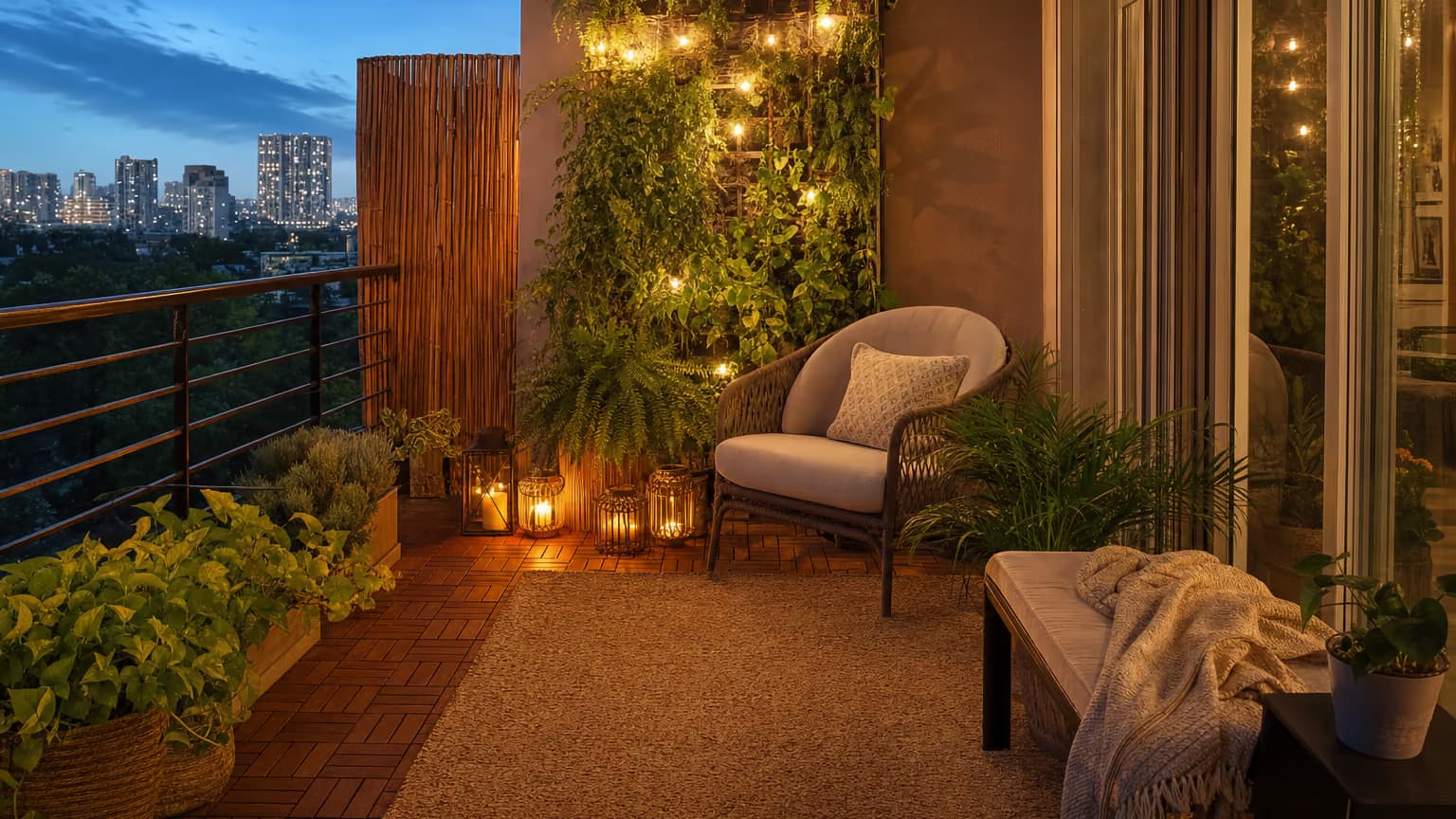
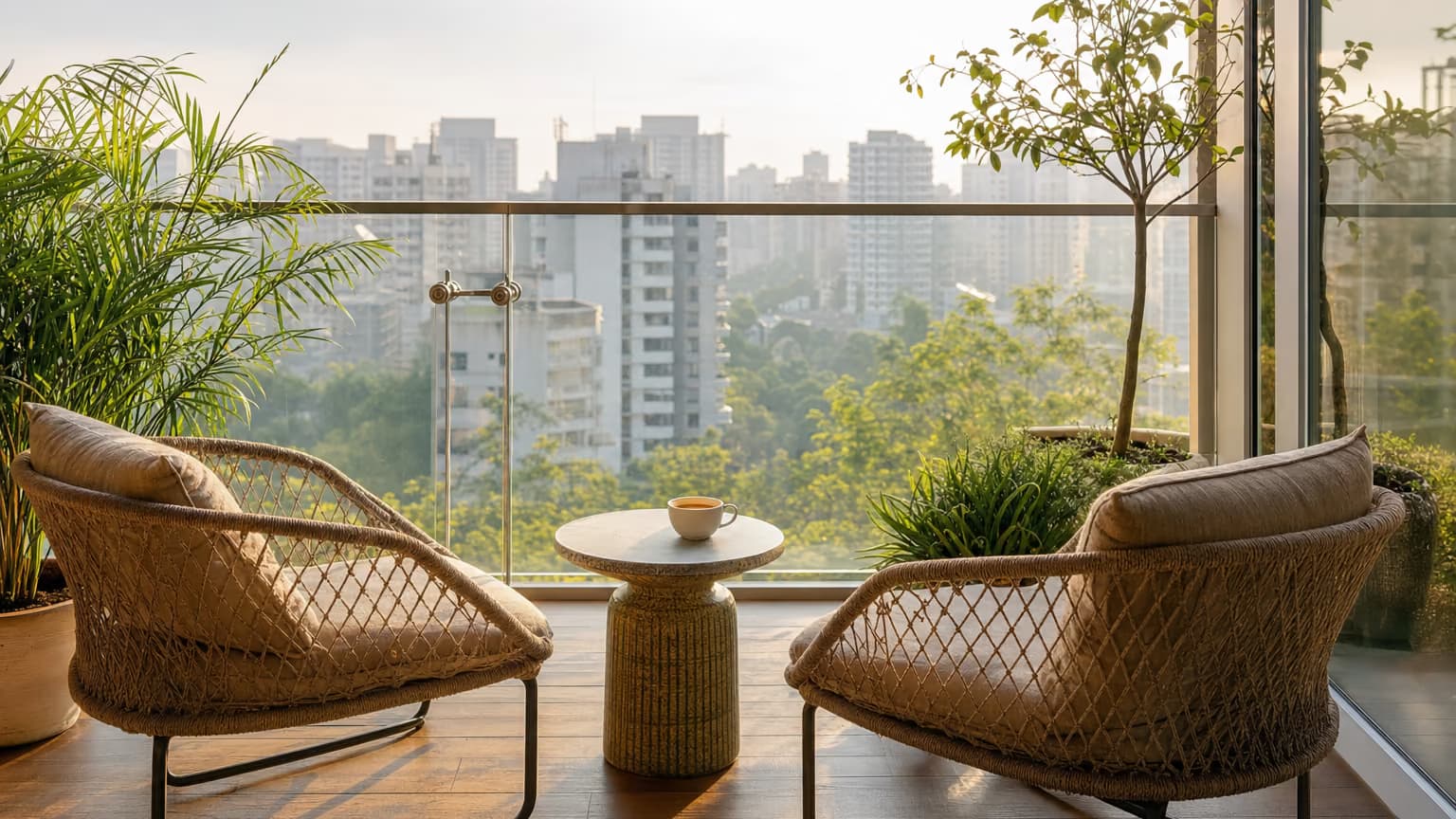
Most Indian balconies are at least partly covered, which sounds like it makes waterproofing less important. In practice it shifts the problem rather than removing it. Wind-driven rain still reaches the outer half, and the sheltered half gets the worse problem of shade, poor airflow and slow drying, which is precisely where mildew starts. If your balcony stays damp and dim through the rains, quick-dry cushions and an open weave matter more than they would in an open garden, not less.
Then there is water that does not fall from the sky. Balcony floors get washed, plant pots overflow, and the drainage slope is rarely where you would like it. Furniture that sits in a thin film of water for hours has a harder life than furniture that gets rained on. Pieces raised on feet, with frames that cannot corrode, handle it without you thinking about it.
Weight matters too. On higher floors wind turns serious before the rain does, and a set that has to be tied down every time the sky darkens is a set you will stop using. Since balconies are rarely a standard size, this is also where made to order earns its place: a set built to your dimensions uses the space you have rather than the space a catalogue assumed.
Coastal rain is a harder version of the same test
If you are buying on the coast, in Mumbai, Goa or Kochi, every one of these decisions gets stricter. Salt in the air accelerates corrosion on anything metal, and the rain arrives in volumes that inland cities do not see. Aluminium's advantage over steel widens considerably here, and quick-dry cushions stop being a nice feature and become the reason your seating is usable in July. Our Mumbai page covers what that means for a coastal home specifically.
The buying checklist: get the claim in writing
Waterproof is a word. Specifications and warranties are commitments. Before you pay, get these five things in writing on the quotation, not verbally.
1. The frame material, named by grade. Not aluminium but powder-coated aluminium, with the coating thickness stated. Not teak but grade-A teak. Not steel but the grade of steel.
2. The weave material. UV-stabilised synthetic wicker or outdoor rope, stated as such, and confirmation that it is woven over a non-corroding frame rather than a hidden steel one.
3. The cushion build. Quick-dry open-cell foam and a solution-dyed UV-resistant fabric. Ask what happens to that cushion after a heavy shower, and how long it takes to dry.
4. The warranty, split by part. A structural period for the frame, weave and hardware, and a separate shorter period for cushion fabric, foam and stitching. One number covering everything is a marketing number.
5. What is being excluded. Normal wear, UV fading and damage from improper care are reasonably excluded by any honest maker. What matters is that they are stated rather than discovered later.
A quote that answers all five is often not the cheapest one in front of you, and that is usually the correct signal rather than a problem. Our outdoor furniture price guide sets out what drives the difference between a low quote and a high one in India.
Final Thought
Waterproof is not a lie in outdoor furniture, but it is a shortcut, and shortcuts hide the part you actually needed to know. The frame either cannot corrode or it can. The cushion either drains or it holds water. Those two facts decide whether a set lasts a decade or a couple of seasons, and neither of them is visible in a photograph.
So take the word off the listing and put it on the quotation instead. Named grades, stated coating, a real cushion specification, and a warranty that treats the frame and the cushions as the different things they are. Every maker who builds properly for Indian weather can produce that document quickly. The ones who cannot are telling you something too.
We make every piece to order from our Noida workshop, in powder-coated aluminium, grade-A teak, handwoven rope and synthetic wicker, with quick-dry foam and UV-resistant fabrics, and we deliver and install across India. You can browse the collections to see what that looks like, message us on WhatsApp with your balcony or terrace dimensions for a quotation, or book an appointment to visit the design studio in Noida and sit on the difference yourself.
Frequently Asked Questions
Individual parts are, but a complete set never is. Powder-coated aluminium, synthetic wicker and HDPE do not let water through at all. Cushions cannot, because foam and fabric are absorbent by nature. Well-built outdoor furniture is designed to manage water rather than block it, so the frame refuses to corrode, the weave lets water pass through, and the foam drains and dries quickly instead of holding moisture inside.
For frames, powder-coated aluminium is the most reliable choice because it contains no iron and cannot rust, and grade-A teak is excellent thanks to its natural oils and dense grain. For seating surfaces, UV-stabilised synthetic wicker or handwoven outdoor rope drain fast because water passes straight through the weave. For cushions, quick-dry open-cell foam with solution-dyed UV-resistant fabric is what you want.
Frames in powder-coated aluminium, grade-A teak, or synthetic wicker and rope over aluminium can stay outdoors permanently with only occasional cleaning. Cushions are different. Quick-dry cushions handle repeated rain without damage, but leaving them out year-round causes fading, which counts as normal wear rather than a defect. Bring them indoors when you are away for a long stretch and use them freely the rest of the time.
No, and any seller claiming otherwise is selling you a word. Good outdoor cushions are quick-dry, which is a different and more useful property. Open-cell foam lets water pass through and out rather than trapping it in the core, and solution-dyed fabric holds its colour because the dye is locked into the fibre. A cushion built this way is usable again within hours of a heavy shower.
Ask for the frame material named by grade, including powder coating thickness on aluminium, the weave material confirmed as UV-stabilised synthetic, and the cushion build stated as quick-dry foam with solution-dyed fabric. Then ask for a written warranty that covers the frame, weave and hardware for one period and the cushions for another, with exclusions spelled out. Get all of it on the quotation.