October 9, 2026
Rooftop Restaurant Design: Furniture Guide for India
Rooftop restaurant design in India, furniture first: zoning, materials, dining and bar sizes, wind, slab load, monsoon storage and where to save.
Quick answer
Rooftop restaurant design in India works when the furniture is chosen for daily service and full exposure. Use powder-coated aluminium frames for dining and bar chairs, with synthetic wicker or rope for woven parts. Keep teak for a few premium pieces. Choose tabletops that wipe clean and drain, cushions with quick-dry foam and removable covers, and pieces heavy enough to stay put in wind but light enough for the slab and the lift. Plan storage for the monsoon before ordering.
What rooftop restaurant design asks of outdoor furniture
A rooftop restaurant is harder on furniture than any home terrace. Chairs are dragged and wiped down several times a day, tables take hot plates and cleaning chemicals, and everything sits in full sun, then takes the monsoon.
That gives four tests for every piece:
- Weather. The frame must not rust or rot, and weaves and fabrics must not fade or crack in strong sun.
- Service. Staff must be able to clean it quickly and move it without damaging the floor.
- Wind. It must not tip or slide in a gust, especially near the parapet.
- Access. It must fit in the lift or up the stairs, and the total load must suit the slab.
If you are planning a rooftop now for the winter season, settle these four before you look at styles.
Zoning a rooftop: dining, lounge and bar
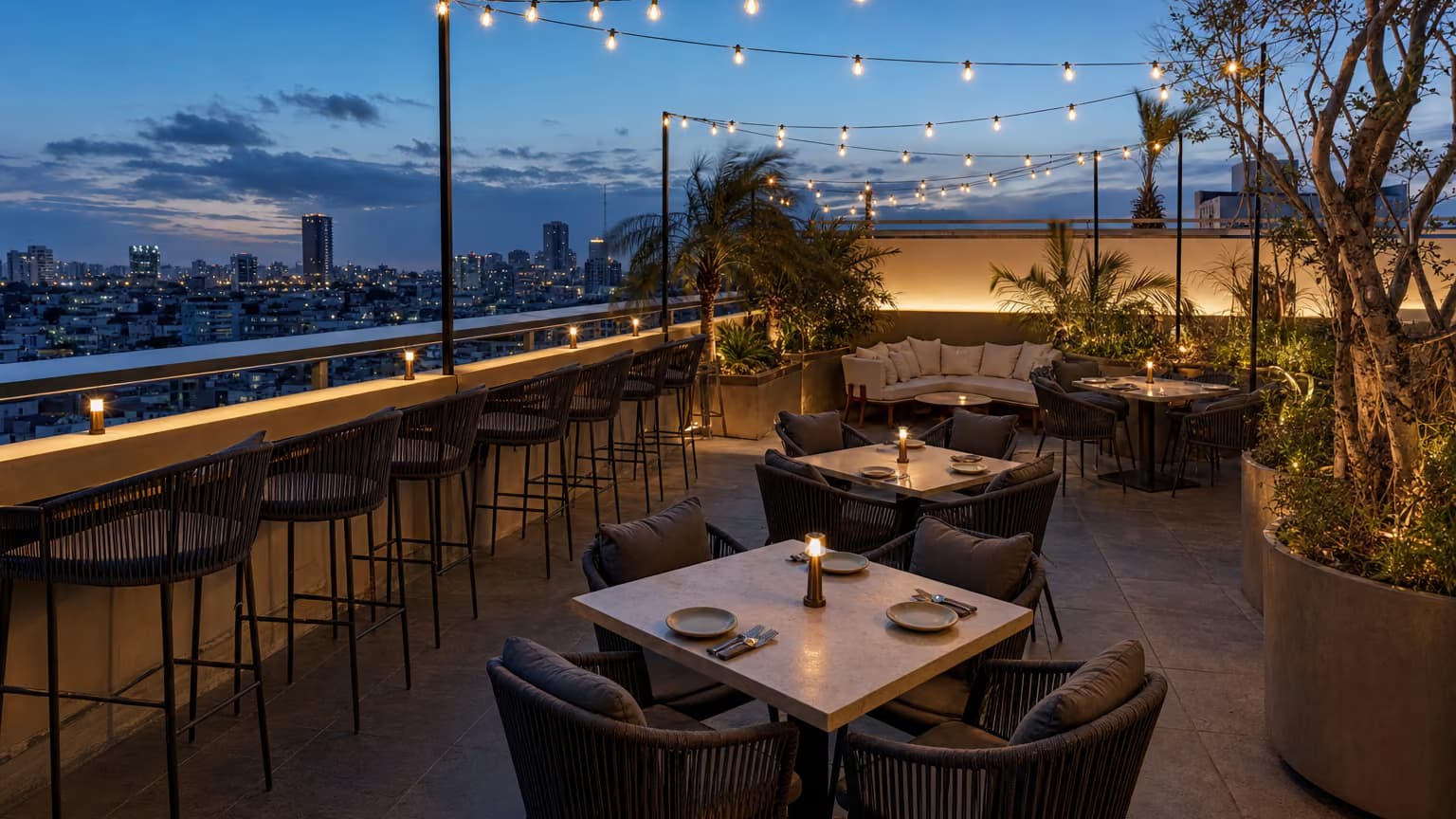
Most rooftop restaurants and cafes work with three zones. Draw them on a floor plan first.
Dining. The main covers, placed closest to the kitchen pass or service stairs, because every plate travels this route. Mix two-seat and four-seat tables so you can join them for larger groups. As a rule of thumb, a two-seater needs a table about 2 ft to 2 ft 6 inches square, a four-seater about 3 ft square, and each diner roughly 2 ft of table edge.
Bar. A counter, a parapet ledge or both. Bar seating fits more guests into a narrow strip than tables do, and it suits the view side of the roof.
Lounge. Sofas, daybeds and lounge chairs for longer evenings. It takes the most space per guest, so keep it to one or two corners with the best view or the most shade.
As a rule of thumb, keep main service aisles at least 3 ft wide, wider near the kitchen door, and leave about 4 ft between the edges of neighbouring tables so seated guests and a server can share the gap. Exit routes and fire rules are set locally, so check them with your architect before the layout is final. Our terrace design ideas post covers shade, flooring and lighting.
Best materials for Indian rooftops
The frame material decides how long a piece lasts in service.
| Material | Where it works on a rooftop | What to watch |
|---|---|---|
| Powder-coated aluminium | Dining chairs, bar chairs, table bases, lounge frames | Coating and weld quality; the all-round choice for heat, humidity and rain |
| Synthetic wicker over aluminium | Lounge sofas, armchairs, dining chairs | Must be UV-stabilised; low-grade weaves fade and turn brittle |
| Handwoven rope over aluminium | Dining chairs, bar chairs, lounge seating | Outdoor-grade rope only; rinse off food and dust regularly |
| Grade-A teak | Feature dining tables, premium lounge pieces | Heavy, and weathers to silver grey unless oiled |
| Mild steel | Avoid in exposed areas | Rusts at scratches and joints, especially near the coast |
| Untreated wood, cane, indoor plywood | Avoid outdoors | Swells, warps and rots in the monsoon |
For a busy rooftop, powder-coated aluminium is the safest base for most pieces, with teak where a few pieces carry the look, such as a communal table.
In Mumbai, Goa, Kochi and Chennai, salt air and heavy rain make rust-proof frames and quick-drying cushions the priority. In Delhi, Jaipur and Ahmedabad, sun and dust come first, so shade and UV-stable weaves matter more. Our teak, aluminium and wicker material guide compares the frames in depth.
Dining chairs and tables built for daily service
Judge a restaurant dining chair on comfort over a full meal and on how fast it can be cleaned.
Chairs. As a rule of thumb, a dining chair seat sits about 17 to 18 inches off the floor, with a table about 29 to 30 inches high. Armchairs need more width per cover than armless chairs. Slatted, rope and woven seats drain after rain.
Tabletops. Pick a surface that wipes clean and does not hold water. Compact laminate is durable and fairly light. Sintered stone and ceramic resist heat but add weight. Aluminium slat tops drain and stay light. Teak looks warm but needs regular care. Toughened glass shows every water mark and suits sheltered spots better than windy edges.
Bases. Adjustable feet stop tables rocking on an uneven roof, and glides under legs protect the floor and the waterproofing below it.
Bar chairs for counters and parapet ledges
Bar seating suits narrow strips along the parapet where a dining table would block the route. Our patio furniture sets guide compares bar, bistro, dining and lounge sets side by side.
As a rule of thumb, a bar counter is about 40 to 42 inches high and takes a bar chair with a seat about 28 to 30 inches high. A counter-height surface of about 36 inches takes a seat of about 24 to 26 inches. Aim for roughly 10 to 12 inches between the seat and the underside of the counter, and about 2 ft of counter length per chair. A ledge about 12 inches deep holds drinks; one serving food is better at about 16 to 18 inches.
A footrest helps on a long evening, and a broad base is steadier on an exposed edge than slim legs. The Arbour bar chair is one example on an aluminium frame. Before fixing a counter to the parapet, have your structural engineer confirm the parapet can take it, and check that guests cannot use a chair to climb onto the edge.
Sofas, daybeds and loungers for premium sections
A lounge corner gives a rooftop its premium seats. Guests tend to stay longer there, so it can carry fewer, more comfortable pieces.
An L-sectional fits a corner and seats a group around one coffee table; keep the table about 14 to 18 inches from the sofa. Modular sofas let you change the layout between a quiet weekday and a full party night. A round daybed under a pergola makes a premium spot for two, but it needs shade. Sun loungers suit rooftops with a pool or deck used by day, as in hotels, and are rarely needed on a dining roof. Every lounge chair needs a side table, and ottomans add seats for a group without another sofa.
Measure the lift and stair turns before choosing sizes; made-to-order pieces can be sized to fit both the corner and the route up.
Cushions and fabrics that cope with sun and rain
Cushions fail before frames do. Use quick-dry foam that lets water drain through, covered in UV-resistant, solution-dyed performance fabric, which holds its colour better in strong sun than surface-printed fabric. Ask for removable zipped covers so staff can wash them, and keep a spare set for each lounge corner. Avoid indoor foam and cotton blends, which hold moisture in humid weather.
Outdoor cushions still last longer when they are brought in at night and through heavy rain, so plan a dry, ventilated store near the rooftop. Our monsoon-proof outdoor furniture guide covers care through the rainy months.
Rooftop logistics: lift access, slab weight and wind
Lift and stairs. Measure the lift door, the lift car and every stair turn. A sofa that fits the plan but not the lift has to be built in sections or hoisted up outside.
Slab weight. Furniture, planters, bar counters, kitchen equipment and a full house of guests all load the roof. Ask your structural engineer what the slab can carry and where heavy items should sit.
Wind. Choose pieces with enough weight and a broad base, keep the lightest seating away from the edges, and close umbrellas when the rooftop is not in service.
Waterproofing and drainage. Do not drill into the roof for fixings without your waterproofing contractor, and keep drain outlets clear of furniture and planters.
Monsoon and building rules. Decide where furniture goes in the heaviest rain, or plan covered seating if you stay open. On a shared building, management may set rules on hours, noise and fixings, and fire, structural and licensing rules apply locally.
Low cost rooftop restaurant design: where to save, where to spend
Low cost rooftop restaurant design means spending where sun and rain will find any weakness, and saving everywhere else.
Spend on:
- Frames for dining and bar chairs, because they take the most use.
- Outdoor fabrics and quick-dry foam on every cushion that stays outside.
- Shade over the lounge and the most-used tables.
- Tabletops that will not stain or swell.
Save on:
- Decor. Planters, lanterns and string lights cost little and can change each season.
- Light fixtures. Simple fittings work well if they are rated for outdoor use; as a rule of thumb, look for IP65 or higher in exposed spots.
- The lounge. Two or three premium pieces in one corner carry the look.
- Matching sets. Two or three chair designs in one finish look intentional and let you buy in smaller batches.
Furniture pricing depends on dimensions, materials and configuration. Our outdoor furniture price guide explains what drives the cost.
Planning a cafe or rooftop project with a manufacturer
A manufacturer can size furniture to the roof rather than the roof to catalogue sizes. Send the maker a floor plan, covers per zone, lift and stair sizes, photographs of the roof and your opening date. Then ask:
- Which materials do you suggest for each zone, and why?
- What are the seat and table heights, and can they match my counters?
- How heavy is each piece, and will the largest fit the lift?
- What does the warranty cover, and how does it apply to daily commercial use?
- How long will production take, and how will delivery and installation reach the roof?
World of Outdoors has furnished restaurants and hotels. Every piece is made to order in our own workshop in Noida, in powder-coated aluminium, grade-A teak, handwoven rope and synthetic wicker. Production takes about 8 weeks as standard, custom designs can take longer, and the team confirms the timeline for each order. Minimum order requirements vary by piece and project, and customers can discuss them with the team. Design consultation is available on request for a small cost, which the team will discuss with you. We deliver across India and arrange installation where specialised installation is needed.
Final Thought
The rooftops whose furniture still looks good after a few seasons are rarely the ones that spent the most. They chose frames and fabrics for the weather, sized every piece to the route up, and planned for wind and rain.
Draw the floor plan, mark the zones, measure the lift and talk to your structural engineer before you order. The furniture choices get much simpler after that.
Every piece we make is made to order in our own workshop in Noida, built to the dimensions of your rooftop. You can browse the collections to see the range, message us on WhatsApp with your floor plan and a few photos, or book an appointment to visit the design studio in Noida.
Frequently Asked Questions
Outdoor seating at a restaurant is usually called al fresco dining, which means eating in the open air. It is also called patio seating, terrace seating or simply an outdoor dining area. On the top floor of a building it is called rooftop seating or rooftop dining. Restaurants often list it as a separate section so guests can ask for a table outside.
Powder-coated aluminium is the most practical frame for most rooftop restaurant furniture in India. It does not rust, it is light enough for staff to move every day, and it can carry woven seats in synthetic wicker or rope for comfort. Teak suits a few premium pieces such as a communal table or a lounge corner. Avoid mild steel, untreated wood and indoor upholstery on any exposed part of the roof.
Start with a clear layout and a few hard-wearing pieces rather than many cheap ones. Spend on chair frames, outdoor fabrics and shade, because sun and rain will expose any weakness there. Save on decor, simple outdoor-rated lights and a small lounge corner instead of lounge seating across the whole roof. Mixing two or three chair designs in one finish also lets you buy in smaller batches.
Choose pieces with some weight and a broad base, and keep the lightest chairs away from the parapet. Close umbrellas whenever the rooftop is not in service, and take cushions in at night and before storms. For anything fixed, such as a pergola, shade sail or bar counter, ask a structural engineer to design the anchoring rather than drilling into the roof yourself.
Plan monsoon storage before you buy. Cushions should go into a dry, ventilated store during heavy rain, even when they use quick-dry foam. Frames in powder-coated aluminium or teak can stay out, but wipe them down and check them after storms. Keep drain outlets clear of furniture and planters, and if you stay open through the rains, move your seating under covered areas.