July 21, 2026
Garden Sitting Area Ideas: Outdoor Seating for Indian Homes
Garden sitting area ideas built for Indian sun, rain and dust. Layouts, space guidance and materials for lawns, farmhouses, poolside and verandahs.
Search for garden sitting area ideas and most of what comes up was written for a different climate. American backyards get four mild seasons and sprinkler systems. English gardens get soft, drizzly rain and long cool evenings. Neither one deals with a Delhi summer that hits 45 degrees, or a Kerala monsoon that can pour for days without a real break, or the fine layer of dust that settles over everything within a week in most Indian cities.
A garden sitting area that actually works here has to answer to that reality. It needs shade that matters at 2 pm, not just at dusk. It needs furniture that survives rain without a fuss. And it needs a layout that fits how Indian households actually use a garden, which is usually a mix of morning chai, evening gatherings, and the occasional large family get-together that needs more seats than you keep out year-round.
This guide is about ground-level outdoor spaces. Gardens, lawns, farmhouse courtyards, poolside decks, and covered verandahs. If you are working with a city balcony or a terrace instead, the space math is different and we cover that separately in our balcony sizing guide. Here, we are talking about real ground and real square footage.
The conversation circle
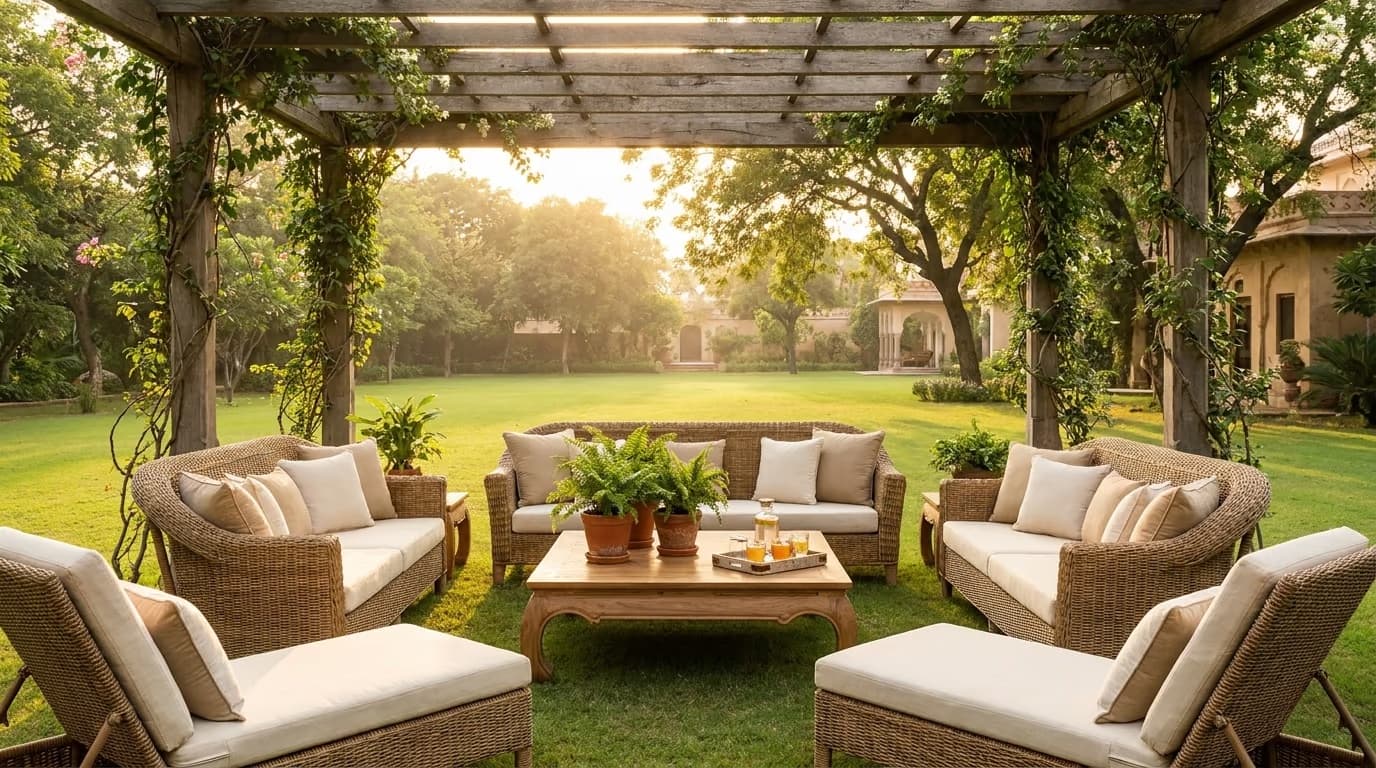
This is the classic garden sitting area idea, and it works because it does what it says. Chairs or a pair of sofas face each other, sometimes with a third or fourth piece completing a square or a loose circle, built around a low coffee table.
For four seats, plan on roughly a 10 by 10 ft area once you include the table and enough room to walk around it without brushing knees. A six-seater version, say two sofas and two chairs, needs closer to 12 by 14 ft. These are rough figures, and the actual footprint depends on how deep the seating is.
Sun matters more here than in most layouts, because people sit facing each other for long stretches, often through the middle of the day when guests visit. If the circle sits in open sun, expect it to be usable only in the morning and evening for a good chunk of the year. A pergola, a large canopy tree, or at minimum a cantilever umbrella changes that. Rain matters too. A conversation circle exposed to weather needs cushions that shrug off a shower, since dragging cushions indoors every time clouds gather gets old fast.
For the frame, powder-coated aluminium is the easiest choice for a piece that sits mostly in the open. It will not rust, it stays light enough to shift for cleaning, and it takes a beating from sun without cracking or fading the way cheaper finishes do. If you want the look of a proper garden lounge, our outdoor sofa buying guide goes deeper into choosing between sofa modules and individual chairs for this exact layout.
The garden lounge corner
This is the layout for the part of the garden that exists purely for lying down and doing nothing. A daybed, a pair of loungers, or a low sectional with deep, soft seating, usually tucked into a corner rather than placed dead center.
A single daybed with a side table needs about 8 by 8 ft to feel comfortable rather than cramped. A pair of loungers with a shared table between them needs roughly 10 by 8 ft. Because people spend longer, more idle stretches here, often reading or napping, shade is not optional the way it might be for a dining table where people eat and move on. A garden lounge corner without real shade tends to sit unused between 11 am and 4 pm for most of the year, which defeats the purpose.
Rain is a bigger concern here too, since a daybed usually carries a thicker cushion than a dining chair, and a soaked cushion takes far longer to dry out. Quick-dry foam matters a lot in this layout, because its open cell structure lets water pass through and drain rather than sitting inside the cushion for days.
Teak works beautifully for a lounge corner because it has the weight and warmth that suits a piece meant for lingering. Left untreated, teak weathers to a soft silver-grey over a season or two, which many homeowners prefer to the honey tone of new wood. If you want to keep the original colour, an occasional oiling does the job.
The outdoor dining zone
Every Indian garden that hosts family lunches needs a dining zone, and this is usually the busiest seating area in the layout. Unlike the conversation circle or the lounge corner, this one gets used at fixed times, mostly lunch and dinner, and needs to seat a specific, often larger, number of people.
A six-seater dining set needs roughly 10 by 12 ft, including space to pull chairs out and walk behind a seated guest. An eight-seater pushes that closer to 12 by 14 ft. If the table sits near a wall or a planter, add a couple of feet on that side so chairs are not scraping against something every time someone stands up.
Because a dining zone gets used at set hours rather than lounged in all day, some shade over just the table, even a simple market umbrella through the table's center, solves most of the sun problem. Rain is a bigger issue for dining than for lounging, since a sudden shower mid-meal is a genuinely bad time to be moving chairs and cutlery. A covered dining zone, even a light open-sided structure, earns its keep here. Our outdoor dining set buying guide covers table shapes and seating counts in more detail if you are sizing one for a specific family.
For material, powder-coated aluminium or a good hardwood both work well for a dining set, since the table gets wiped down often anyway. If dust is a bigger issue in your area than rain, an easy-to-clean surface, like glass or a sealed wood top, saves a lot of daily effort.
The poolside setup
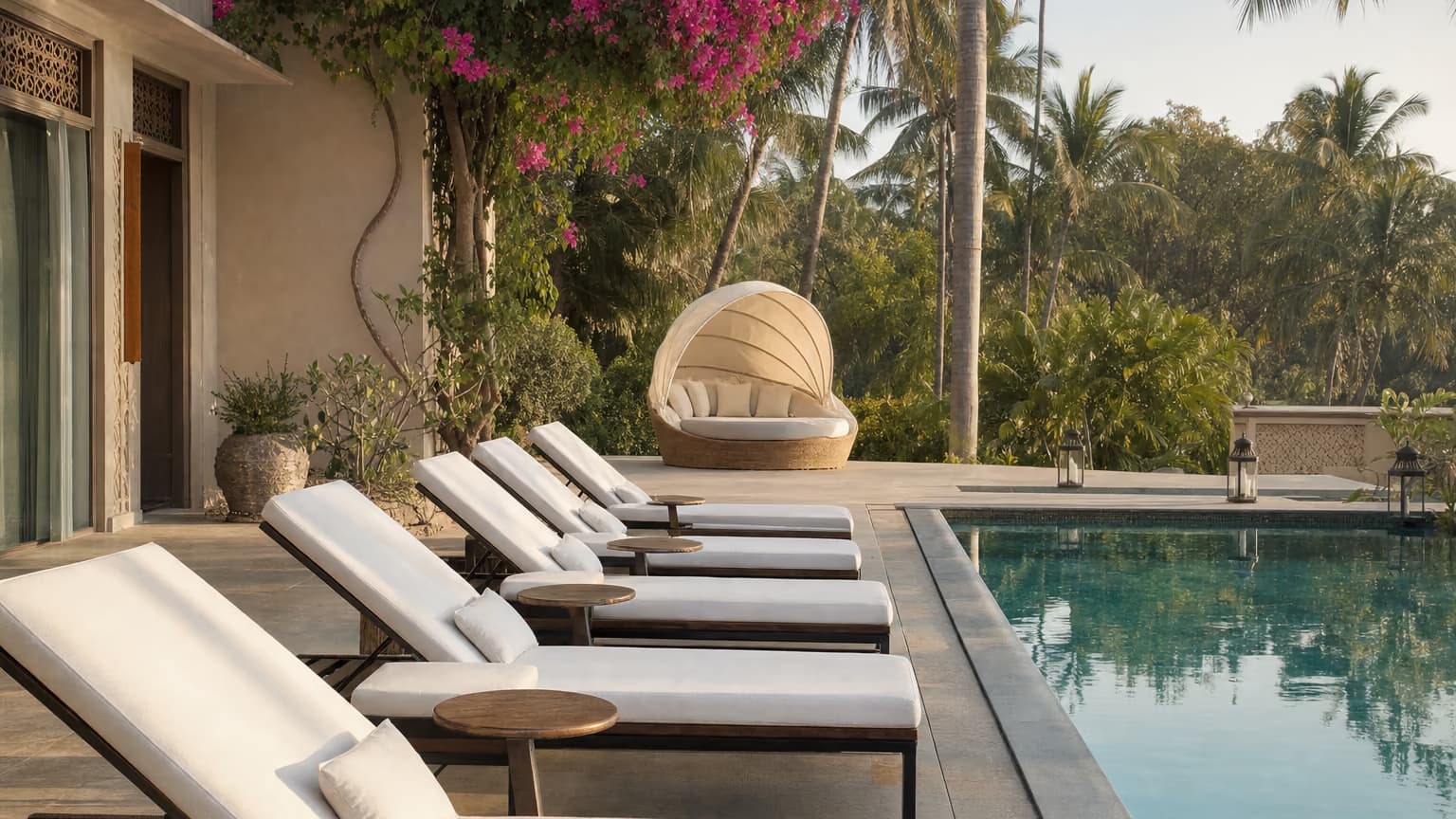
Poolside seating has its own set of rules, mostly because of water splash, wet feet, and near-constant sun exposure if the pool sits in an open part of the garden. For a full pool deck plan, including clearances, shade and materials, see our poolside furniture and design guide.
Loungers are the anchor piece here, and each one needs roughly 3 by 7 ft of dedicated space, plus a small side table for every two loungers. A cluster of four loungers with tables typically needs about 15 by 10 ft, giving enough room to walk between them without stepping over legs.
Sun here is usually a given rather than a variable, since most pools are placed for maximum daylight. The real decision is how much shade to introduce without blocking the point of a lounger, which many people use specifically to catch the sun. A few shaded loungers alongside a few in open sun, or a large umbrella that can be angled through the day, gives people a choice. Rain and splash both call for the same solution: quick-dry foam and fabrics that do not hold water, since poolside furniture gets wet from the pool itself even on a dry day.
Powder-coated aluminium is close to the default choice for poolside frames, since it handles both chlorinated splash and constant sun without corroding or fading the way lesser metals do.
The verandah or covered porch
A verandah changes the entire equation because the roof already handles sun and rain. This is often the most comfortable seating area in an Indian home for exactly that reason, and it is where furniture choices can afford to be less weather-obsessed and more about comfort and finish.
A small verandah seating cluster, two chairs and a side table, fits in about 6 by 6 ft. A fuller verandah lounge, with a two-seater bench or a small sofa plus chairs, needs closer to 10 by 8 ft. Because a verandah is covered, driving rain from the side is really the only weather risk, so orientation relative to the prevailing monsoon direction is worth thinking about before you commit to a layout.
Since the roof already protects the furniture, this is a good spot for a handwoven wicker or rope-and-aluminium piece, since it brings texture that would feel out of place fully exposed to sun and rain. A verandah is also where a matching garden furniture set tends to look most intentional, since the covered space frames it like a room rather than scattering it across open lawn.
Planning a garden sitting area that works for the whole year
Before choosing furniture, it helps to think through three things that decide whether any of these layouts will actually get used through the year.
Start with sun orientation. Walk the garden at 8 am, 1 pm, and 5 pm over a couple of days, and note which spots stay shaded and which sit in full sun. A conversation circle or lounge corner placed without checking this often ends up unused for the hottest months, even if it looks perfect in a plan drawing.
Next, decide on shade. A pergola is permanent and gives the most reliable, evenly distributed shade, but it is also the most involved to build. A large umbrella is flexible, cheaper, and can be folded away, but it only shades one cluster at a time. Tree cover is free and often beautiful, but it is seasonal, since some trees shed leaves before summer and others do not fill out until after the first rains. Most gardens end up using a mix of all three.
Finally, leave circulation space. It is tempting to fill a garden with as much seating as it can hold, but a sitting area needs clear paths for people to walk to it, around it, and away from it without squeezing past a chair. A rough rule that works for most layouts is to leave at least 3 ft of walking space around any seating cluster, more if the path also serves as the route to the pool, the dining zone, or the house.
Weather resilience is worth planning for from day one rather than fixing it after the first monsoon damages a set. Our monsoon-proof outdoor furniture guide and our material guide to teak, aluminium and wicker go into which materials hold up and why.
Every garden is a different shape, gets a different amount of sun, and holds a different number of people on an ordinary evening versus a family gathering. Made-to-order sizing means the seating is built for that actual garden rather than picked from whatever standard dimensions happen to be in stock. If you want to see what fits your space, browse our collections, look through past projects for ideas, or get in touch through our contact page to book an appointment at the Noida design studio.
Frequently Asked Questions
It depends heavily on the layout. A simple two-chair verandah cluster fits in about 6 by 6 ft, while a six-seater dining zone or a four-seater conversation circle each need roughly 10 by 10 to 12 ft. Poolside clusters and larger lounges tend to need the most room, often 12 by 14 ft or more once tables and walking space are included. Measure the actual area before buying, since made-to-order furniture can be sized to fit rather than forcing a fit around standard dimensions.
Frames matter most. Powder-coated aluminium does not rust because it contains no iron, and it handles both sun and rain with very little maintenance. Grade-A teak has natural oils that resist water and insects, and it ages gracefully rather than deteriorating. For woven pieces, synthetic wicker or handwoven rope holds up far better outdoors than natural cane or bamboo, which absorb water and sag over time. Whatever the frame, cushions in quick-dry foam and UV-resistant fabric last longest, since they do not hold water or fade under repeated sun exposure.
Covering helps mainly for pieces that will sit unused for stretches, and only if the cover is breathable rather than airtight. A sealed cover thrown over damp furniture traps moisture underneath and can do more harm than leaving it exposed, since it creates the still, humid conditions mildew needs. If the furniture is genuinely weather-resistant and gets used through the season, covers are more useful for storage than for daily protection.
A garden lounge is a relaxed seating area built around daybeds, loungers, or deep-seated sofas rather than upright dining chairs, meant for reading, napping, or unwinding rather than for meals or formal conversation. It usually sits in its own corner of the garden, ideally shaded, since it is where people spend the longest, most idle stretches of time outdoors.
Consistency across pieces makes the biggest visible difference. A matching garden furniture set, rather than pieces bought separately over time, reads as intentional rather than accidental. Beyond that, proportion matters: furniture sized to the actual space rather than squeezed in or lost in it looks considered. Quality materials that age well, like teak that weathers to grey rather than a finish that peels, also carry a sense of permanence that cheaper furniture rarely achieves.