November 6, 2026
Veranda and Sit Out Design Ideas for Indian Homes
Veranda and sit-out design ideas for Indian homes: layouts by size, furniture for blown-in rain, sun and dust, and Kerala-style sit-outs.
Quick answer
A veranda or sit-out is a roofed, open-sided space attached to the house, so its furniture must cope with rain blowing in from the sides, low sun moving across it and dust settling every day. Plan by usable depth first. Under 5 ft suits slim chairs and a side table, 5 to 7 ft takes two lounge chairs or a 2-seater sofa, and deeper verandas take a full sofa group. Choose rust-proof frames, quick-dry foam and solution-dyed fabric, and keep the path to the door clear.
What is a sit-out, and what does it need from furniture?
A sit-out, also written sitout, is the covered seating space just outside the house, usually beside the front door. A veranda, also spelt verandah, is the same idea stretched longer: a roofed space open on at least one side, running along one or more walls. Many Indian homes use the two words for the same place, and front porch is the nearest English term.
A roof makes the space feel like an indoor room, so people move indoor chairs out and watch them fail within a season. A veranda is still outdoors.
Rain blows in. Wind drives monsoon rain under the roof. Seats against the house wall often stay dry while seats near the open edge get soaked.
The sun moves across. Morning and evening sun comes in low under the eaves, so cushions on an east or west-facing veranda can take hours of direct sun a day.
Dust settles. A veranda faces the road, the gate or the garden. Pieces that wipe clean matter more than delicate textures.
Veranda layouts by size
Measure the usable depth from the house wall to the edge of the floor or the line of pillars, then subtract anything fixed: the door swing, the steps, a shoe rack. Depth decides what fits far more than length does. The figures below are rules of thumb, not fixed standards.
| Usable depth | What fits well | Space to keep clear (rule of thumb) |
|---|---|---|
| Under 5 ft | Slim armchairs or a bench about 2 ft deep against the wall, a small side table between them | About 2 to 3 ft in front of the seats to walk past; skip the coffee table |
| 5 to 7 ft | Two lounge chairs with a side table, or a 2-seater sofa, with a low ottoman instead of a coffee table | About 2.5 to 3 ft clear in front of the seats |
| 7 to 10 ft | A 3-seater sofa against the wall, a coffee table, and a lounge chair at each end facing in | 14 to 18 inches between sofa and coffee table, and about 3 ft of path in front of or around the group |
| Over 10 ft, or wraparound | Two separate groups, such as a sofa group and a daybed or swing corner, or an L-shaped sectional in a corner | About 3 ft for main paths, more at the front door |
Long and narrow is a common Indian veranda shape, and it is where furniture built to the exact length helps most. A sofa made to fit the run between two pillars avoids the awkward gap a standard size leaves.
Front sit-out by the entrance
The front sit-out is one of the busiest parts of the house. Shoes come off here, deliveries arrive and guests are greeted. As a rule of thumb, keep about 3 ft clear from the steps to the main door, and keep the door's full swing open.
Set the seating against the wall to one side of the door, facing the gate or garden. Two lounge chairs with a side table between them is the classic arrangement, and a pair is easy to move when the floor is washed. The Perennial single seater is one chair that works in pairs.
For a sit-out design for a small house, one comfortable chair, a side table and an ottoman that doubles as a second seat is enough. Skip the coffee table near the door, where it ends up holding parcels and helmets.
Long or side veranda
A long veranda along the side of the house tempts people to line every chair up against the wall. That works for watching the garden and fails for conversation.
Make one seating group at the end nearest the door, with two chairs angled towards a 2-seater or 3-seater sofa, so people face each other. Use the far end for something different: a lounger, a round daybed or a swing. Keep the middle as a walkway.
A common rule of thumb is a coffee table about two-thirds the length of the sofa. On a narrow veranda, a slim rectangular table or two side tables work better than a square one.
Wraparound veranda
A wraparound veranda runs along two or more sides of the house, which gives you a morning side and an evening side. Put the main seating where the afternoon is shaded, which in most Indian homes is the east or north side, because the hot afternoon sun comes from the west.
The corner where two sides meet is the natural place for an L-shaped sectional. The sunnier side becomes a seasonal spot. In North India, a lounge chair or round daybed on a south-facing stretch makes good use of the winter sun; the Arbour round daybed is one option for that corner.
Upper-floor and closed sit-outs
An upper-floor covered veranda, often a deep balcony under the slab above, takes more wind and blown-in rain than a ground-floor one. Keep cushioned seating towards the wall and choose frames light enough to pull back before a storm.
Many families close a sit-out for security, dust or privacy, and the method changes what the furniture needs.
Grills add security but change nothing about the weather. Furnish it as an open veranda.
Glass keeps out rain and most dust, but traps heat and humidity, and sun through glass still fades fabric. Keep vents or sliding panels open where you can, and use outdoor fabric wherever the sun falls.
Jali or louvred screens cut sun and give privacy while letting air through. Fine rain still gets in during a storm.
A closed sitout design often works well as a reading or tea corner with a single lounge chair or a daybed.
Kerala-style sit-outs and humid climates
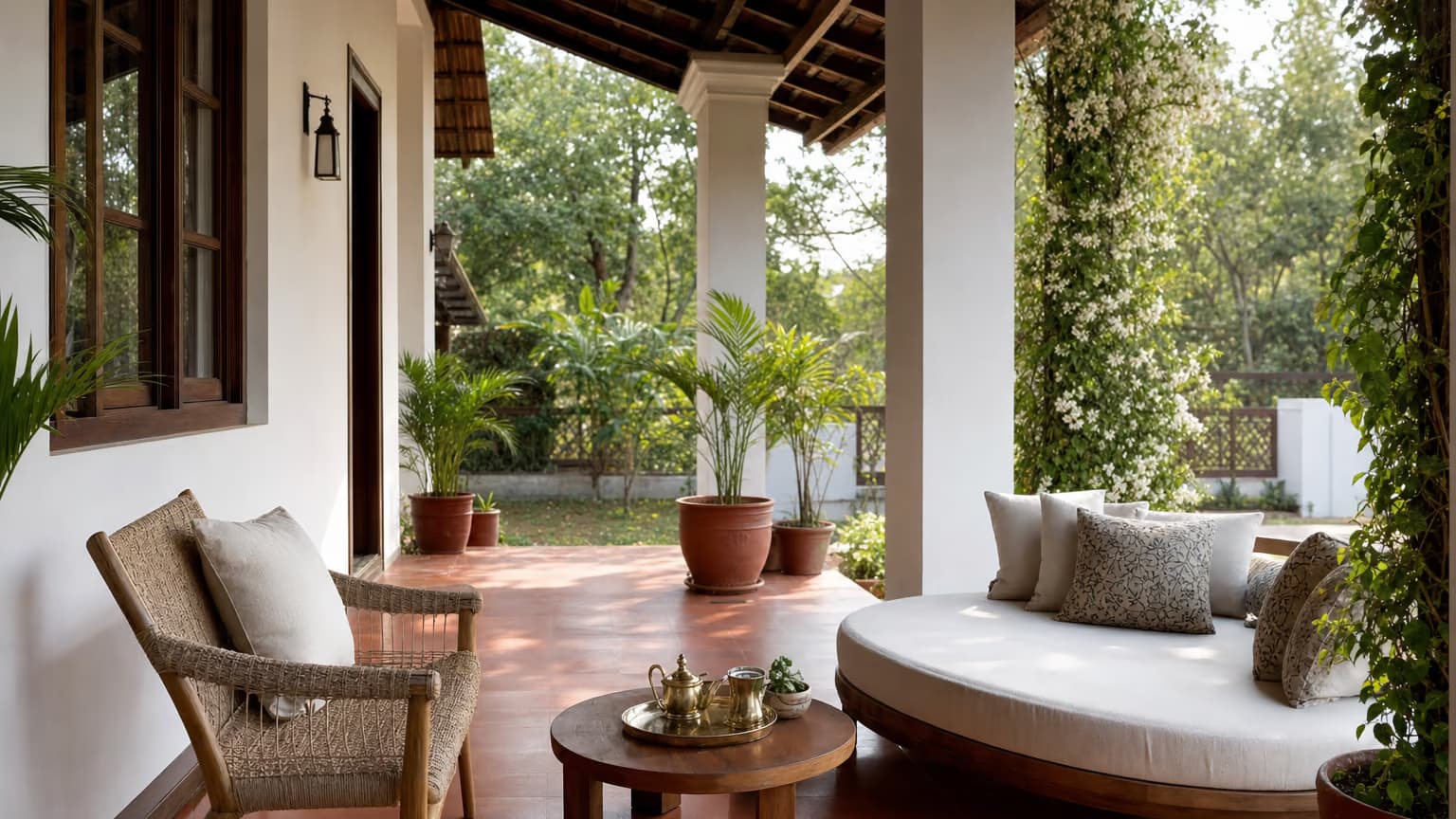
Sit-outs in Kerala and much of coastal South India are built for heavy monsoons and humid air that lasts most of the year. Typical features include deep eaves on a sloping tiled roof, a raised plinth with steps, pillars at the open edge and, in traditional homes, a built-in seat along that edge with a sloping wooden backrest. Loose furniture should sit alongside this architecture, not crowd it. Two lounge chairs and a side table often look better than a full sofa set.
Humidity is the real test. Cushions that hold water grow mildew, so choose quick-dry foam with removable covers. Leave a gap between furniture and the wall so air moves behind it. Near the sea, choose rust-proof frames and stainless or coated hardware. Grade-A teak suits the traditional look, and our Kerala coastal outdoor furniture guide covers salt air and monsoon care.
Materials and fabrics for rain, sun and dust
Powder-coated aluminium does not rust, wipes clean quickly and is light enough to pull back from the edge before a storm.
Grade-A teak handles sun and rain well. Left untreated it weathers to silver grey; periodic oiling keeps the honey colour.
Synthetic wicker and handwoven rope do not rot when wet, and tighter weaves hold less dust.
Cushions matter as much as frames. Quick-dry foam lets water drain through instead of soaking in. UV-resistant, solution-dyed fabric has colour running through the fibre rather than printed on top, so it fades more slowly. Mid-tones and textured weaves hide dust better than white or very dark fabric. In heavy rain, bring cushions in or stand them on edge against the wall.
Avoid untreated steel, which rusts at the joints, and indoor upholstery. Our guide to teak, aluminium and wicker compares the frames in detail.
We make every piece to order in our own workshop in Noida with these materials, sized to the length and depth of your veranda. Orders usually take about 8 weeks as standard, custom designs can take longer, and the team confirms the timeline with each order. Our catalogue furniture carries a five-year structural warranty covering the frame in aluminium or teak, the weave construction, and hardware and fittings, and a one-year cushion warranty covering fabric defects, foam compression and stitching. Normal wear, UV fading and improper care are not covered.
Swings and jhulas on a veranda
A veranda is the traditional place for a jhula, as long as the roof can carry it. A ceiling-hung bench swing needs a structural concrete slab or beam, checked by a structural engineer before anyone drills. A light sheet or timber roof usually cannot take one, so choose a swing on its own stand instead.
As a rule of thumb, allow roughly 2 ft in front of and 2 ft behind the seat for the arc, and keep it clear of pillars and the door. Use stainless or galvanised hardware, because chains and hooks are where rust starts.
We build swings to order, though they are not in the catalogue, and the team confirms the terms for each one. Our swing and jhula buying guide covers load ratings, sizes and mounting.
Lighting, fans and shade
On the low-sun side, roll-down outdoor blinds, bamboo chiks or creepers on a trellis cut the glare while letting air through. A ceiling fan makes a humid veranda usable on still evenings. For lights, choose fittings rated IP65 or higher wherever rain reaches, have a licensed electrician add earth leakage protection, and use warm wall lights rather than one bright tube.
Final Thought
The verandas that get used every day are rarely the most decorated ones. They are the ones where the seating sits out of the rain, the afternoon sun is blocked, and nobody squeezes past a chair to reach the door.
Before buying anything, measure the usable depth, note where rain comes in and where the evening sun falls, and decide what the space is for: tea for two, a family group or a quiet daybed corner. The furniture follows from that.
Every piece we make is made to order in our own workshop in Noida, sized to your veranda, and we deliver across India. You can browse our outdoor furniture collections to see the range, message us on WhatsApp with your sit-out measurements and a few photos, or book an appointment to visit the design studio in Noida.
Frequently Asked Questions
A sitout is a covered seating area just outside the house, usually beside the main entrance. It has a roof but is open on at least one side. Many Indian homes use sitout, sit-out, veranda and verandah for the same space. Because wind, rain, sun and dust all reach it, a sitout needs outdoor furniture rather than indoor pieces moved outside.
Start with one seating arrangement, such as two lounge chairs and a side table against the wall, facing the garden or gate. Keep the path to the door clear. Add a few planters at the open edge, a warm wall light and cushions in a colour that ties back to the house. Keep decor to pieces that wipe clean, because dust settles daily.
Choose fewer, better pieces. One or two slim lounge chairs with a side table, or a compact 2-seater sofa, usually fit best. An ottoman can work as a footrest, a table or an extra seat. Skip the coffee table if the space is under about 5 ft deep. Furniture made to the exact width avoids awkward gaps between pillars.
Frames in powder-coated aluminium, grade-A teak, synthetic wicker or outdoor rope can usually stay out on a covered veranda. Cushions need more care. Quick-dry foam and solution-dyed fabric recover well from a soaking, but in heavy storms bring cushions in or stand them on edge. Move seating back from the open edge before the rains and wipe frames after storms.
As a rule of thumb, a strip under about 5 ft deep fits only slim chairs or a bench against the wall with room to walk past. Around 5 to 7 ft takes two lounge chairs or a 2-seater sofa with a path in front. From about 7 ft, a full sofa group with a coffee table fits. Measure from the wall to the edge, minus the door swing.