September 15, 2026
Balcony Chairs: A Buying Guide for Indian Apartments
Balcony chairs and table-and-chair sets for Indian apartments: which type suits your balcony, how to size it, and what makes a chair comfortable.
Quick answer
The best balcony chair is the one that fits how you use the space. For a solo reading spot, choose a single lounge chair with a side table. For tea or meals for two, choose a bistro set of two dining-height chairs and a small round table. For a railing with a view, choose bar chairs at a ledge. Pick an outdoor frame in powder-coated aluminium, teak, rope or synthetic wicker, with quick-dry cushions, and keep a clear walkway in front of every seat.
What are the best chairs for a balcony?
The best chairs for a balcony are outdoor-rated chairs sized to your depth and chosen for one clear use: lounging, eating or perching at the railing. A chair that tries to do all three usually does none of them well, and a balcony rarely has room for a second attempt.
So start with the use, not the look. For morning tea alone, one comfortable armchair beats a four-piece set. For breakfast for two, you need upright chairs at table height, not low loungers.
This guide is about the chairs themselves. For full layouts on a compact balcony, see our small balcony furniture guide, and for ideas across every size of space, our balcony and terrace furniture ideas.
What are balcony chairs called?
Balcony chairs have no single name. They are sold as outdoor chairs, patio chairs or sit-out chairs, then named by shape: lounge chairs, armchairs or single seaters, bistro or dining chairs, bar chairs, swing chairs, folding chairs and rocking chairs. The shape name is the useful one, because each shape has a different seat height and depth.
In India you will also hear chairs named by material: cane chairs, rope chairs, wicker chairs, jute chairs. That describes the material, not the shape, so ask for both.
What are the different types of chairs for balconies?
There are eight common types of balcony chair, and each suits a different use and footprint. The table gives rough guidance; for exact balcony depths and what fits each, use our standard balcony size guide.
| Chair type | Best for | Footprint guidance | Notes |
|---|---|---|---|
| Lounge chair | Reading, long evenings | The largest; allow its full depth plus clear space in front | Low and reclined, so not for eating at a table |
| Armchair or single seater | Everyday sitting, tea | Mid-sized; arms add width | The most versatile balcony chair |
| Bistro or dining chair | Meals, working | Compact, like an indoor dining chair | Needs a table at dining height and room to slide back |
| Bar chair | A counter or wide railing ledge | Small on the floor, tall | Only works with a surface at bar or counter height |
| Rope or woven chair | Any shape, with a lighter look | Same as the shape it takes | Dries fast if the weave is synthetic |
| Swing or jhula | A focal point | Clear floor plus swing room on every side | Needs a structural mount |
| Folding chair | Very shallow balconies | Smallest in use, flat when stored | Least comfortable for long sittings |
| Rocking chair | Slow evenings, one person | Extra depth for runners and movement | Creeps on sloped floors |
Lounge chair
A lounge chair sits low and deep with a reclined back, which makes it the most comfortable choice for long sittings. It suits a one-person retreat and does not suit eating, because the seat is too low for a table. Our Arbour single lounge chair is one example.
Armchair or single seater
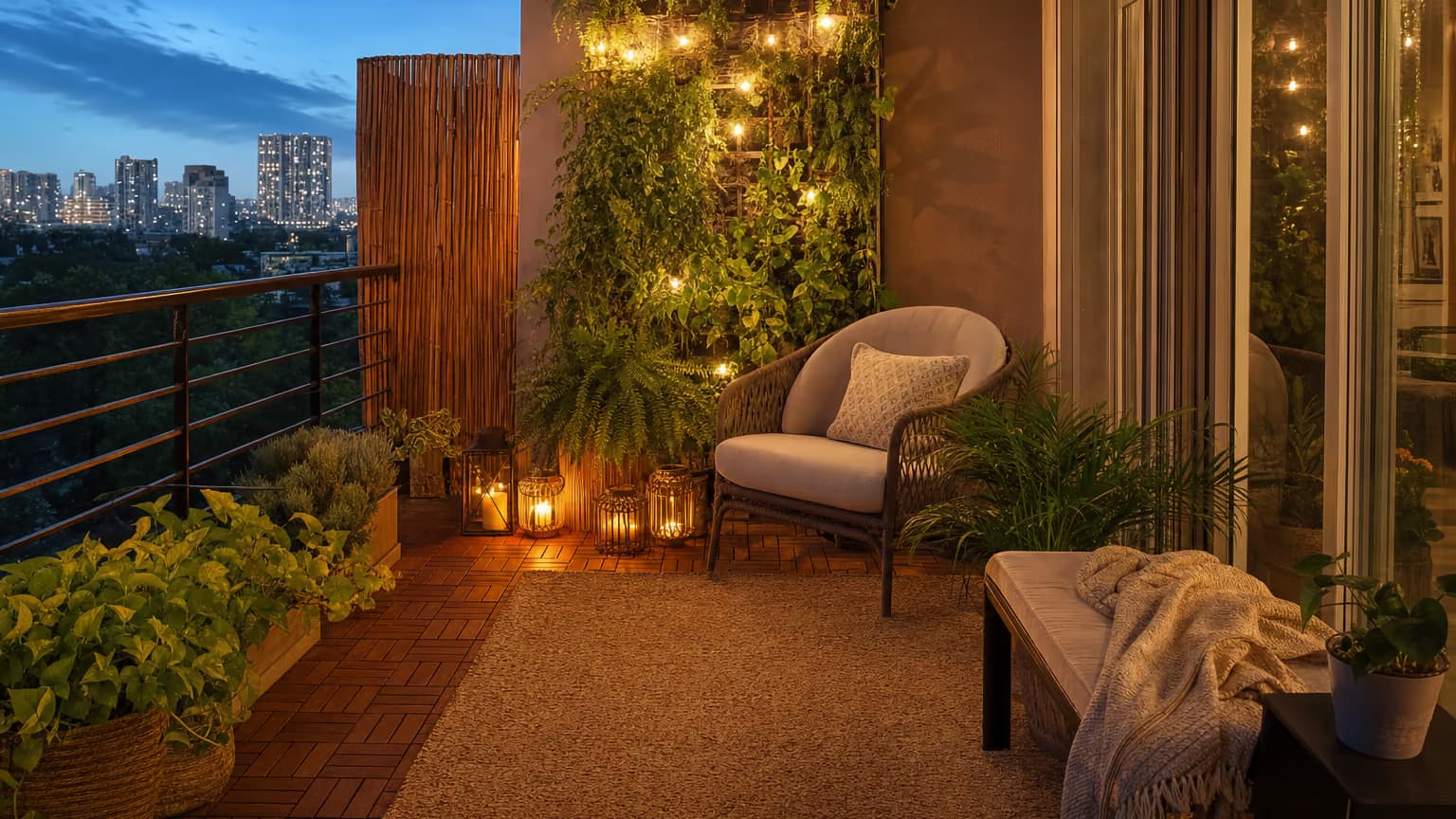
An armchair or single seater is upright enough for tea and soft enough to stay in for an hour, which makes it the safest buy for most balconies. A rope-detailed frame such as our Fern single seater looks lighter on a narrow balcony than a solid one.
Bistro or dining chair
A bistro or dining chair is upright and built to pull up to a table, so choose it if you eat or work outside. Our Amalfi dining chair is one example, from a collection with rope accents and deep cushions.
Bar chair
A bar chair only makes sense with a counter-height surface to sit at: a wide railing ledge, a topped planter wall, or a narrow bar table along the railing. Its advantage is the view over a solid parapet. See our Arbour bar chair.
Swing or jhula
A swing or jhula is the most loved and the most demanding balcony seat. It needs a ceiling or frame that can take the load, and room to move without touching the railing or wall, so check the slab and mounting with your building management or a structural engineer first. We build outdoor swings on request, and a dedicated guide to balcony swings is coming soon.
Folding, rocking and woven chairs
A folding chair is the answer when permanent seating would block a very shallow balcony, but it is rarely comfortable for more than half an hour. A rocking chair needs more depth than its seat suggests, because the runners extend and the chair travels as it rocks. Rope and woven chairs are a material choice on any of these shapes: synthetic wicker and outdoor rope drain through the weave, while natural cane and jute absorb moisture and belong on a fully covered balcony.
Balcony table and chairs: which set-up suits your space?
A balcony table and chairs set-up comes down to three layouts: two chairs and a side table, a bistro set, or a single lounger. Choose by use first and depth second.
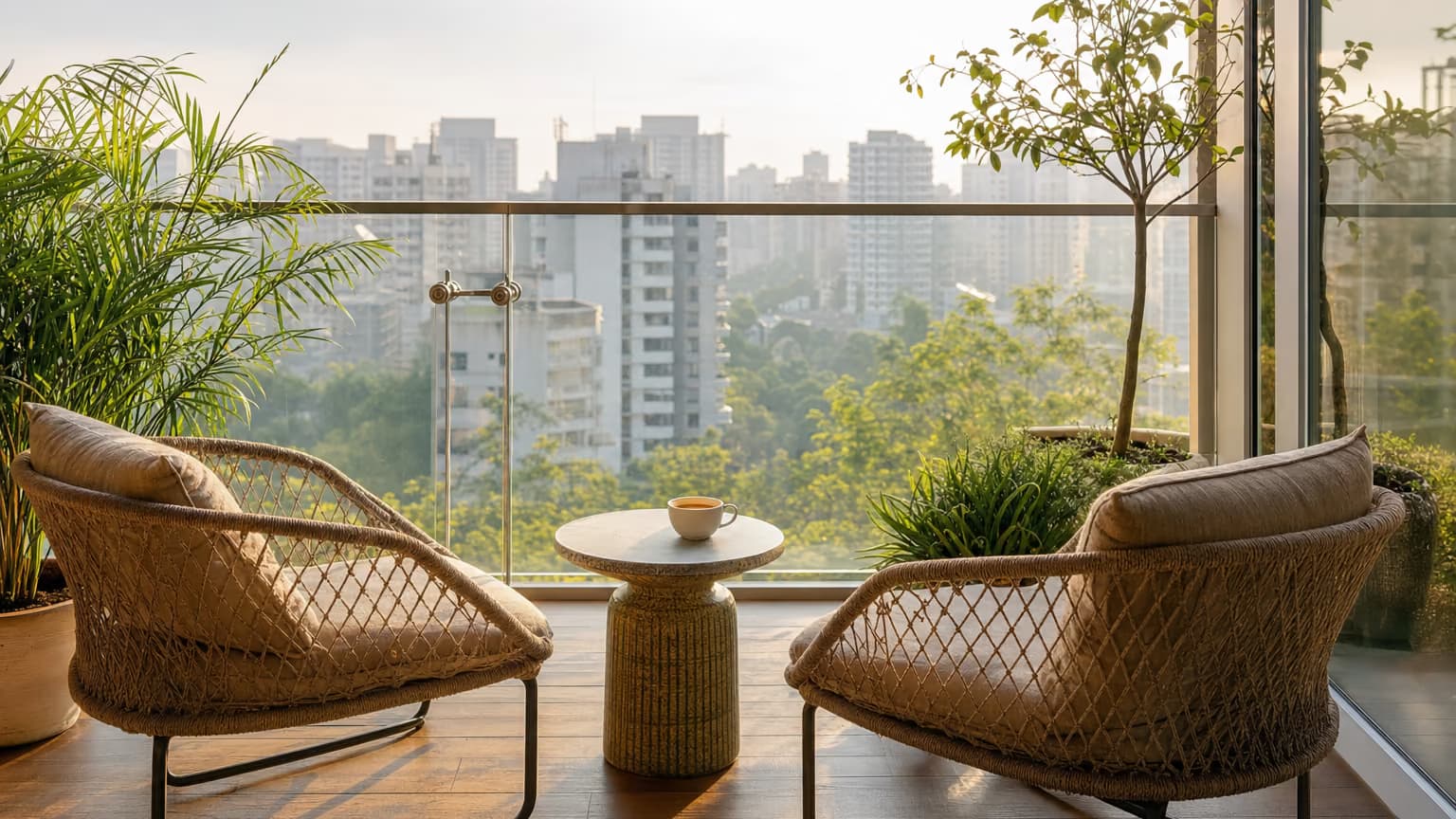
Two chairs and a side table. Two armchairs side by side or angled slightly inwards, with a small side table between them. This is the layout for conversation and tea. It uses the width of the balcony rather than the depth, so it suits long, shallow balconies. Keep the table small, such as our Fern side table, so a cup is within reach from either seat.
Bistro set. Two dining-height chairs facing each other across a small round table. This is the layout for eating. It uses depth, because the chairs must slide back from the table, so it suits balconies deeper than they are long.
Single lounger or lounge chair. One generous chair angled towards the view, with a side table within reach. On a small balcony, one excellent chair often feels better than two average ones.
For a larger table on a terrace, our outdoor dining set buying guide covers that in depth.
How to size a chair to your balcony
Size a balcony chair by three measurements: overall depth, overall width including arms, and the walkway left in front. Depth decides whether a chair works at all.
Overall depth. A chair's listed depth runs from the front of the seat to the back of the frame or the end of the recline. Compare that with your balcony depth, not the seat depth.
Arm width. Arms add width on both sides, and wide flat arms add more. On a narrow balcony, slim arms or an armless chair can recover several inches, often the difference between two chairs fitting side by side or not.
Clear walkway. As a rule of thumb, leave at least 2 feet of clear floor in front of a seat so you can stand up, and keep a clear path from the door to the railing. A dining chair needs a little more, because it slides back before anyone sits.
A quick test: mark the chair's footprint on the floor with masking tape, then add the walkway in front. If the tape reaches the railing, the chair is too big for that spot. When no standard chair fits, a chair built to your measurements will. We build to your exact dimensions, including narrow and L-shaped balconies.
What is the most comfortable chair for a balcony?
The most comfortable balcony chair is usually a lounge chair or a deep single seater with a slightly reclined back and a thick quick-dry cushion. Comfort is decided by four things more than by chair type.
Seat height. As a rule of thumb, your feet should rest flat on the floor with your knees at or slightly below hip level. A lower seat lets you stretch out; a dining seat must sit comfortably below the table.
Seat depth. A deeper seat lets you sit back and tuck your legs up. For shorter people it can leave the backrest out of reach, so check that the front edge does not press into the back of your knees.
Back angle. An upright back suits eating and working; a slightly reclined one suits reading. Too much recline makes a chair hard to get out of, which matters for older family members.
Cushion build. A thicker cushion is softer only if the foam is dense enough not to bottom out. Outdoors it also has to drain. Quick-dry foam is open-cell, so water runs through and a cushion caught in a shower is usable again in hours.
Which materials suit balcony exposure?
The right material depends on how exposed the balcony is, and the frame and cushion should be judged separately. A frame is a long-term structural choice. A cushion is a comfort layer that wears and fades, however good it is.
Sun. West-facing and upper-floor balconies take hours of afternoon sun. Powder-coated aluminium handles UV without trouble, and grade-A teak weathers to silver-grey if left unoiled. Fabrics should be UV-resistant and solution-dyed, with the colour running through the fibre.
Rain. Even a covered balcony gets wind-driven rain on its outer half. Aluminium cannot rust, synthetic wicker and rope let water through, and quick-dry foam drains. Mild steel, natural cane and ordinary upholstery foam are what fail. Our waterproof outdoor furniture guide explains what each weather claim means.
Dust. City balconies collect fine dust daily. Smooth frames and open weaves wipe clean easily, and washable cushion covers make a real difference over a year.
Coastal air. Salt speeds up corrosion on metal, which widens aluminium's advantage over steel. Our Mumbai page covers coastal homes, and our Bangalore page covers homes in Bangalore. For a full frame comparison, see our teak, aluminium and wicker material guide.
Do balcony chairs need to be heavy on high floors?
On high floors, a balcony chair needs enough weight or a wide enough base to stay put in a gust. Wind strengthens with height, and a light chair that sits happily on a first-floor balcony can shift or tip much higher up.
That is a real trade-off. Aluminium is light and easy to move, but a very light chair with a narrow base is the one most likely to shift in a pre-monsoon storm. Teak stays put but is harder to rearrange.
On a high or exposed balcony, choose a wide stance and a low centre of gravity over tall, narrow shapes, be cautious with bar chairs, and bring loose cushions in when a storm is forecast. A cushion is usually the first thing to leave the balcony.
What to check before you buy a balcony chair
- Real depth and width, measured at the narrowest point, minus the door swing and any AC unit.
- Full footprint, including recline and arms.
- Clear walkway, tested with tape on the floor.
- Frame material, named on the quote: powder-coated aluminium, grade-A teak, synthetic wicker or outdoor rope.
- Cushion build: quick-dry foam, UV-resistant solution-dyed fabric, removable covers.
- Chair and table heights that match, if you are buying a set.
- Warranty split by part: one period for the frame, weave and hardware, another for the cushions.
Pricing depends on dimensions, materials and configuration, so compare quotes on the same specification. Our outdoor furniture price guide explains what drives the difference.
Final Thought
A balcony chair is a small purchase that gets used more than almost anything else in the house, if it is right. The right one is chosen by use, sized to the real depth, and built from materials that do not mind rain and sun.
Most disappointing balcony chairs are too big to stand up from, too upright to relax in, or made for indoors. Avoid those three and the chair earns its place every morning.
We make every piece to order in our Noida workshop, in powder-coated aluminium, grade-A teak, handwoven rope and synthetic wicker, with quick-dry foam cushions, and we deliver and install across India. Browse the collections to see the chairs and side tables, message us on WhatsApp with your balcony dimensions for a quotation, or book an appointment to visit the design studio in Noida and plan your balcony in person.
Frequently Asked Questions
The best balcony chairs are outdoor-rated chairs sized to the depth of the balcony and chosen for one clear use. A single lounge chair suits solo relaxing, a bistro set of two dining-height chairs suits meals, and bar chairs suit a railing ledge with a view. Look for powder-coated aluminium, teak, synthetic wicker or rope frames with quick-dry cushions, and leave a clear walkway in front of each seat.
Balcony chairs are usually sold as outdoor chairs, patio chairs or sit-out chairs, then named by shape. The common shapes are lounge chairs, armchairs or single seaters, bistro or dining chairs, bar chairs, swing chairs or jhulas, folding chairs and rocking chairs. In India they are also named by material, such as cane, rope, wicker or jute chairs, which describes what the chair is made of rather than how it sits.
A lounge chair or deep single seater with a slightly reclined back and a thick quick-dry cushion is usually the most comfortable. Check four things: a seat height that keeps your feet flat on the floor, a seat depth that does not press into the back of your knees, a back angle that suits how you sit, and dense foam that does not bottom out. Sit in it for ten minutes before deciding.
The main types are lounge chairs for relaxing, armchairs or single seaters for everyday sitting, bistro or dining chairs for meals, bar chairs for a counter or railing ledge, rope or woven chairs, swings or jhulas, folding chairs for very shallow balconies, and rocking chairs. Each has a different footprint and seat height, so choose by how you will use the balcony first and by how much depth you have second.
It depends on the shape of the balcony and how you use it. Two armchairs with a side table between them sit along the width, so they suit long, shallow balconies and conversation over tea. A bistro set needs depth, because the chairs must slide back from the table, so it suits deeper balconies and eating outside. If you rarely eat on the balcony, two armchairs are usually more comfortable.
Natural cane and jute chairs work on a fully covered balcony that stays dry, but they absorb moisture, so rain and humidity make them swell, sag and grow mildew. On a balcony that gets any rain, synthetic wicker or outdoor rope over an aluminium frame gives a similar woven look and dries quickly because water passes straight through the weave.