October 2, 2026
Balcony Jhula and Garden Swing Buying Guide for India
How to choose a balcony jhula or garden swing in India: types, ceiling or stand, load rating, space, materials and monsoon care.
Quick answer
The best swing for a balcony depends on what holds it up. If the balcony has a solid concrete slab or beam, your building management or a structural engineer approves the anchor, and there is at least 4 feet of depth, a ceiling-hung chair works. If any of that is missing, choose a swing with its own stand. Then check the load rating, leave room for the swing to move, and pick a rust-proof frame with quick-dry, UV-resistant cushions.
Which swing is best for a balcony?
The best swing for a balcony is the one your balcony can safely carry, so start with the ceiling, not the catalogue. A ceiling-hung swing needs a structural concrete slab or beam and permission to drill. A swing with a stand needs neither, which makes it the safer default for most apartments and every rented flat.
Size decides the rest. On a typical apartment balcony, a single hanging chair, often called an egg chair or pod swing, gives you the feel of a jhula without the long arc of a bench swing. A 2-seater bench jhula suits a deeper balcony, a covered verandah or a terrace. A 2 to 3 seater garden swing with a canopy belongs on a lawn or a large terrace, and our terrace sitting area ideas show where seating works best on a roof.
Our balcony chairs buying guide compares a swing with other balcony seats.
Types of swings: ceiling jhula, swing with stand, hanging chair and garden swing
A balcony swing is called a jhula, jhoola, swing chair, hanging chair, egg chair or porch swing. The name matters less than the type, because each type mounts and moves differently.
| Type | Best for | How it is held up | Space it needs (rule of thumb) | Watch out for |
|---|---|---|---|---|
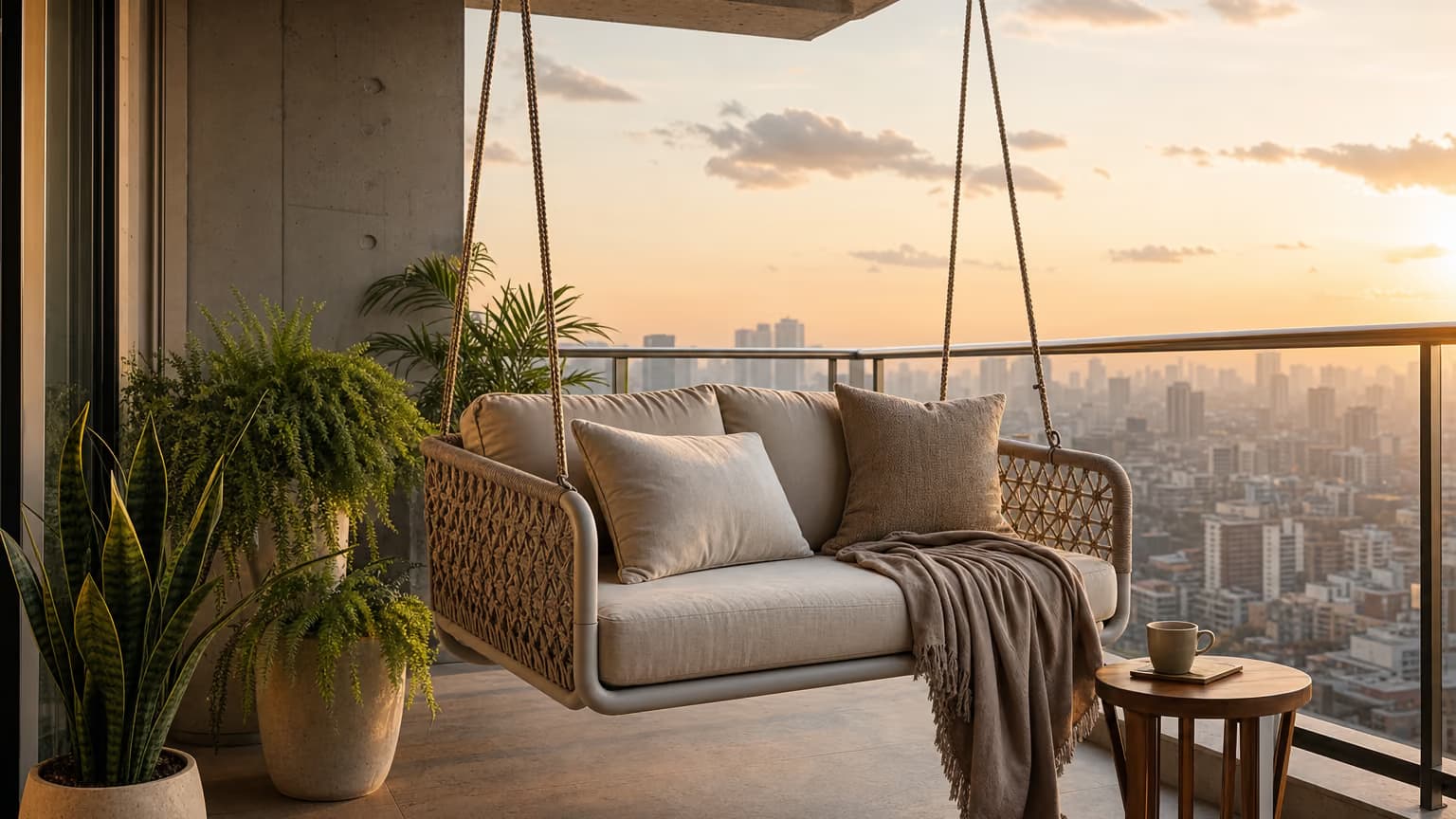
| Hanging chair (egg or pod) | Small and medium balconies | One ceiling hook, or its own stand | About 3 by 3 feet of clear floor plus swing clearance, so plan for about 4 feet of depth | Spinning and drifting in wind on high floors |
| Swing chair with stand | Rented flats, balconies with no structural ceiling | Its own curved or C-shaped stand | The full footprint of the base, which is larger than the seat | A narrow base that rocks when you sit |
| Ceiling jhula (bench on chains) | Covered verandahs, deeper balconies, terraces | Two anchors into a slab or beam | The bench depth plus roughly 2 feet in front and 2 feet behind for the arc | Hitting the railing, wall or glass door |
| Garden swing (2 to 3 seater, with canopy) | Lawns, large terraces, farmhouses | A freestanding A-frame or box frame | The frame footprint plus a walkway around it | Wind catching the canopy, uneven ground |
Hammocks and macrame swings are mostly decorative, and cotton rope does not suit sun and rain.
Ceiling-hung or freestanding: can your ceiling take a jhula?
Only a structural reinforced concrete slab or beam can take a ceiling-hung swing, and only after someone qualified has checked it. Before anyone drills, have the slab and the anchor checked by your building management or a structural engineer.
Never hang a swing from a false ceiling. Gypsum, POP and wooden panels are decoration. The anchor has to go into the concrete above them.
Never fix a swing to the railing or parapet. Railings are built to stop people falling, not to carry a moving load.
Respect the moving load. A swing in motion pulls harder on its hook than the same people sitting still, and that pull repeats with every swing. So the hook, chain, shackles and anchor all need a rating well above the weight of the people using it.
In a rented flat, or where the society will not approve drilling, a freestanding swing avoids all of this at the cost of floor space. A heavy steel multi-seater is a concentrated load, so ask the same question about the floor.
What load rating to look for
Choose a clearly stated maximum load comfortably above the combined weight of the heaviest people likely to sit together. As a rule of thumb, a 2-seater family swing should be rated for at least about 200 kg, and a larger garden swing more. A product that says it seats two or three but gives no load rating is a reason to look elsewhere.
The rating has to hold across every part: the frame or stand, the chains, the hook, the shackles and, for a ceiling swing, the anchor. The weakest part is the real rating. Chains, S-hooks, bolts and weld joints are where swings usually fail and where rust starts, so prefer stainless steel or galvanised hardware outdoors.
How much space does a swing need?
As a rule of thumb, a single-seat swing needs about 3 by 3 feet of clear floor plus swing clearance, so plan for a 4 foot depth and a strong ceiling or frame mount. A bench jhula needs more, for the arc shown in the table above. Our standard balcony size guide shows how to measure the usable depth.
Measure these before you order:
- Usable depth and width at the narrowest point, after the door swing and any AC unit.
- The full movement. Push the swing to the end of its arc and check that nothing is within reach: not the railing, a glass door or a planter.
- Ceiling height for a hanging chair or jhula. The chains should let the seat sit at about normal chair height, with your feet flat on the floor.
- The stand footprint. Measure the base, not the seat, because curved stands reach well beyond the chair.
Keep a swing away from the outer railing, especially if children use it.
Materials that survive Indian weather
For an open balcony or garden, choose a frame that does not rust or rot, an outdoor weave and corrosion-resistant hardware.
Powder-coated aluminium does not rust, which suits coastal cities and open balconies. It is lighter than steel, so a freestanding swing gets its stability from the width of the base.
Powder-coated or galvanised steel is strong and heavy, which suits large stands and garden swings. It resists rust only while the coating is intact, so touch up chips before the monsoon.
Grade-A teak suits a traditional bench jhula or a verandah swing. It handles sun and rain well, weathers to silver grey if left untreated and keeps its colour with periodic oiling.
Synthetic wicker and outdoor rope give the look of cane without its weaknesses.
Natural cane, bamboo and untreated iron are best kept indoors or on a fully covered balcony. Rain and strong sun split natural fibres, and untreated iron rusts quickly.
For a fuller comparison, see our teak, aluminium and wicker material guide.
Cushions, canopy and monsoon care
On an outdoor swing, how fast a cushion dries matters more than how thick it looks. Look for quick-dry foam, UV-resistant solution-dyed fabric and zip-off covers. Ordinary foam soaks up rain and stays damp for days.
A few habits add years to a swing:
- Bring cushions in during heavy rain and when you travel.
- Use a fitted cover in the monsoon, and air the swing on sunny days so damp is not trapped.
- Check the hardware before and after the monsoon for rust, loose bolts and wear where chain meets hook.
- Tie back a hanging chair on a windy, high balcony so it cannot swing into the glass.
- Lower the canopy on a garden swing before a storm, because it catches wind like a sail.
A 2-seater jhula for the balcony or a garden swing for the family?
Choose a 2-seater jhula for a deep, covered balcony or verandah with a structural slab above it. Choose a garden swing when it will stand on a lawn or large terrace and the whole family will use it.
A good 2-seater jhula seats two adults without touching and has a back you can lean into. Many swings sold as 2-seaters are snug, so check the seat width. On a shallow apartment balcony, a 2-seater on a stand, which moves less, or a single hanging chair is the practical alternative.
A garden swing is usually a 2 or 3 seater on a freestanding frame with a canopy. Look for a wide, braced frame on level ground, a removable canopy and afternoon shade. Our garden sitting area guide covers planning the seating around it.
What does a swing cost, and what drives the price?
There is no single price for a swing. The cost depends on the type, size, frame material, weave, cushions and mounting.
- Frame. Aluminium and teak cost more than steel, and heavier sections cost more than thin tubing.
- Weave. Handwoven rope or synthetic wicker takes more labour than a slatted seat.
- Cushions. Quick-dry foam and performance fabric cost more than standard upholstery and last far longer outdoors.
- Mounting. A stand adds frame cost. A ceiling swing adds rated hardware, the anchor, the structural check and the person who fixes it.
Our outdoor furniture price guide explains how these factors add up.
When a made-to-order swing makes sense
Made to order makes sense when a standard size does not fit: an L-shaped balcony, a bench that must fit between two verandah pillars, or a swing that should match the rest of your outdoor furniture.
We build outdoor swings on request. They are not in our catalogue. Each is made to order in our own workshop in Noida, using the materials we work with across our range: powder-coated aluminium, grade-A teak, handwoven rope, synthetic wicker and quick-dry cushions in UV-resistant fabric. The standard timeline is about 8 weeks, custom designs can take longer, and the team confirms it for each order.
Our standard warranty on catalogue furniture is a five-year structural warranty covering the frame in aluminium or teak, the weave construction, and hardware and fittings, plus a one-year cushion warranty covering fabric defects, foam compression and stitching. Normal wear, UV fading and improper care are not covered. Because a swing is a custom piece, the team confirms its warranty terms with each order. For a ceiling-hung swing, the slab and anchor check still sits with your building management or a structural engineer.
Final Thought
A swing is the most loved seat on an Indian balcony, and the one that asks the most of the space. Most of the decision is made before you look at designs: what holds it up and how far it moves.
Check the ceiling, or the floor it will stand on, first. The type, size and materials follow from that.
Every piece we make is made to order in our own workshop in Noida, and we deliver across India. You can browse the collections to see our materials and finishes, message us on WhatsApp with your balcony or garden measurements and a few photos, or book an appointment to visit the design studio in Noida.
Frequently Asked Questions
For most apartment balconies, a single hanging chair on a stand is the safest and most practical jhula, because it needs no drilling and fits a small floor. If you have a structural concrete slab, approval to drill and enough depth, a ceiling-hung chair or bench jhula is a good choice. On an open balcony, pick a rust-proof frame such as powder-coated aluminium, an outdoor weave and quick-dry cushions with UV-resistant fabric.
The cost of a swing chair depends on its size, frame material, weave, cushions and mounting. A single hanging chair usually costs less than a 2 or 3 seater garden swing, and teak or aluminium frames cost more than painted steel. A ceiling-hung swing also needs rated hardware, an anchor and a structural check. Made-to-order swings cost more than standard sizes because they are built to your dimensions and materials.
The best freestanding outdoor swing has a wide, braced base that does not rock when you sit, a rust-proof frame such as powder-coated aluminium or well-coated steel, and a clearly stated load rating. For a garden, an A-frame swing with an adjustable or removable canopy is the most stable shape. Look for stainless or galvanised hardware, quick-dry cushions and non-slip feet if it will stand on tiles.
A patio swing is worth it when you have the space and a safe way to hold it up. It becomes the spot people use every evening, and the gentle movement makes it more relaxing than a fixed chair. It is not worth it on a balcony too shallow for the swing to move freely, or under a ceiling that has not been checked. In those cases, a lounge chair or a swing on a stand works better.
Make the swing the focal point and keep everything else simple. Place it in a corner against the main wall, with a small side table beside it for a cup of tea. Add planters along the railing side, warm lighting on the wall and cushions in one or two colours that suit the room inside. Leave the area around the swing clear so it can move without hitting anything.