September 22, 2026
Balcony Decoration Ideas: A Makeover Plan for Indian Flats
Balcony decoration ideas for Indian flats, planned in order: floor, walls, plants by sun, lighting, textiles and seating, plus budget tips.
Quick answer
The best balcony makeovers start with one question: what will you actually do out there? Decide that first, then work in layers. Cover the floor with interlocking deck tiles or an outdoor rug, dress the walls and railing with planters or a privacy screen, choose plants by how many hours of direct sun the balcony gets, add warm outdoor-rated lighting, and finish with quick-dry cushions. Seating is the anchor, so spend there and save on decor. Check drainage, planter weight and society rules before you buy anything.
Start with what the balcony is for
Most balcony decoration ideas start with a photograph. A better start is a sentence, such as "I want tea here at 7 am." That sentence decides almost every choice that follows.
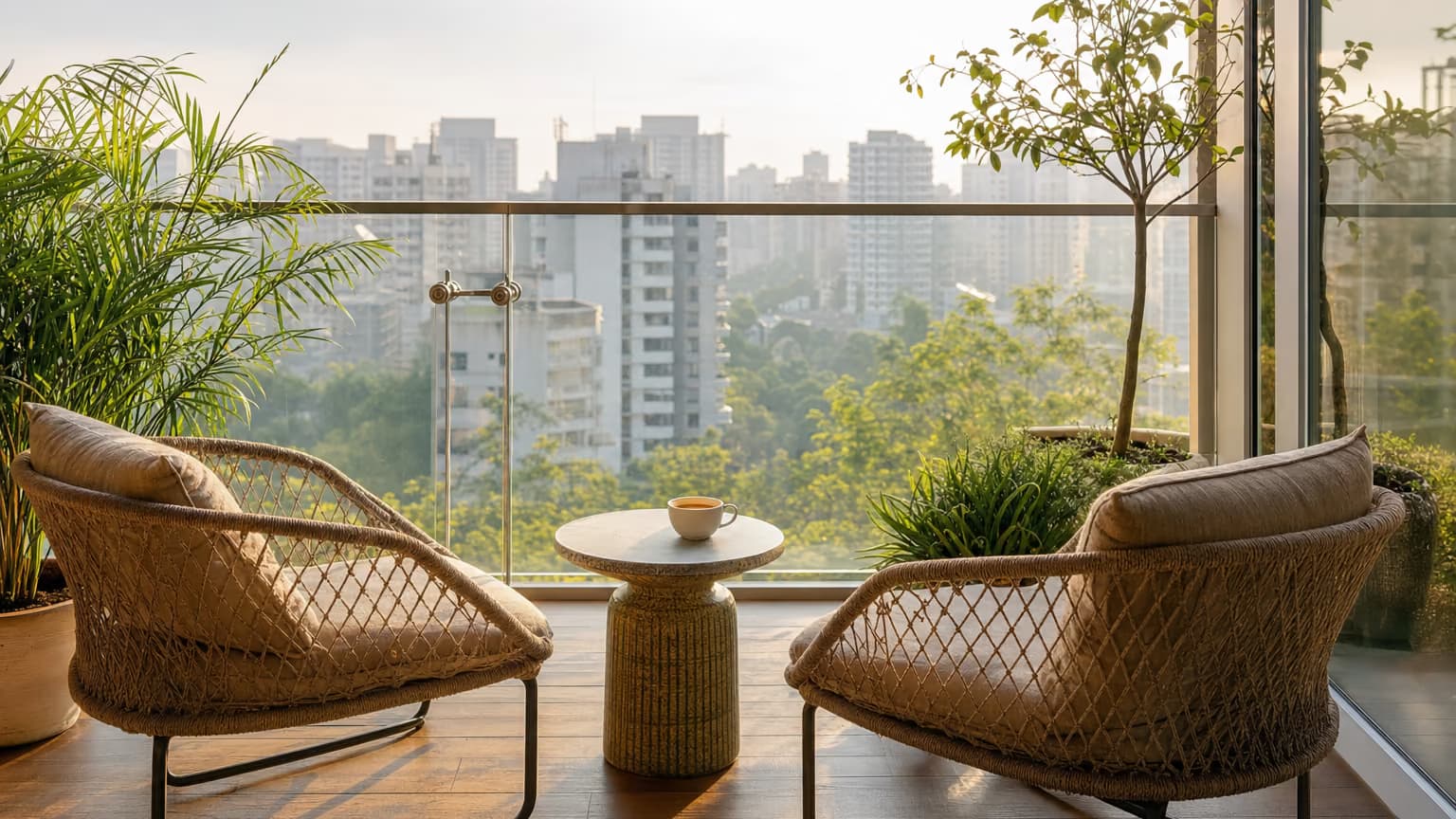
Morning tea. One comfortable chair, a surface within reach, something green to look at. East-facing balconies suit this because the sun is gentle early and gone by the heat of the day.
Working or reading. A chair with a proper back rather than a lounger, a side table, shade over the screen, and a light for evenings.
Plants. Floor space goes to planters and a path for watering. Drainage and weight become the main concerns, and seating shrinks to one chair.
Hosting. Seats for four or more, somewhere to put drinks down, and lighting that works after dark.
Pick one main use and one secondary use at most. For what your balcony can physically fit, see our guide to standard balcony sizes in India and our small balcony furniture guide, which covers layouts. This post is about the makeover itself.
The makeover in layers
Work from the floor up, because each layer affects the next. Planters placed before you lay deck tiles have to be moved again. One exception: decide where the seat will go on day one, even though you buy it last, so the lights and planters are placed around it.
Layer 1: the floor
The floor is the largest surface on a balcony and the one most people ignore.
Interlocking deck tiles are the simplest balcony makeover for most Indian flats. They are square tiles, usually around 1 ft by 1 ft, in wood-look composite, polymer or stone finishes, that click together over the existing floor with no adhesive. Water runs underneath to the drain, and they lift out, which makes them a good choice for tenants.
Outdoor rugs are the budget option. Choose polypropylene or another outdoor synthetic, because it dries quickly and does not rot. Cotton and jute rugs turn musty within a week of monsoon damp.
Either way, keep the floor drain uncovered and reachable.
Layer 2: walls and railings
Walls and railings give a balcony most of its character, and they cost no floor space.
Vertical gardens and wall planters. A modular frame on one wall, or pots on a wall-mounted rail, puts greenery at eye level.
Railing planters. Check your society rules first. Many housing societies do not allow anything fixed to the outside face of a railing, and a pot falling from height is dangerous. Keep planters on the inner side and secure them.
Cladding. One feature wall in exterior-grade stone-look panels, composite slats or textured exterior paint gives a finished look. Interior wallpaper and interior paint blister and peel outside.
Privacy for overlooked flats. If the balcony faces another tower, privacy often matters more than decoration. Outdoor roller blinds in mesh or PVC, bamboo chiks, slatted screens or a row of tall plants block the line of sight while letting air through. On glass railings, frosted film on the lower half works well. Avoid fully solid screens, which make a balcony hot and slow to dry.
Layer 3: plants, chosen by sun exposure
Balcony plants mostly fail because they are chosen for looks rather than light. Count the hours of direct sun your balcony gets before you buy. In India, south- and west-facing balconies get the most sun, east-facing ones get gentler morning sun, and north-facing ones get the least.
Full sun (roughly 5 hours or more). Bougainvillea, hibiscus, adenium, portulaca, succulents, lemongrass, tulsi and curry leaf all do well. West-facing balconies also take harsh afternoon heat, so water early or late and use larger pots so the soil does not dry out by noon.
Partial sun (roughly 2 to 4 hours, usually morning). Money plant, spider plant, areca palm, syngonium, mint and most ferns.
Shade (little or no direct sun). Snake plant, ZZ plant, peace lily, philodendron and pothos cope with low light on a deeply covered or north-facing balcony.
Everywhere, use pots with drainage holes and saucers so water does not run onto the balcony below, and use a lightweight potting mix such as cocopeat blended with compost rather than garden soil. Wet soil is far heavier than most people expect.
Layer 4: lighting
Lighting makes a balcony usable after dark, which in much of India is when it is cool enough to sit out.
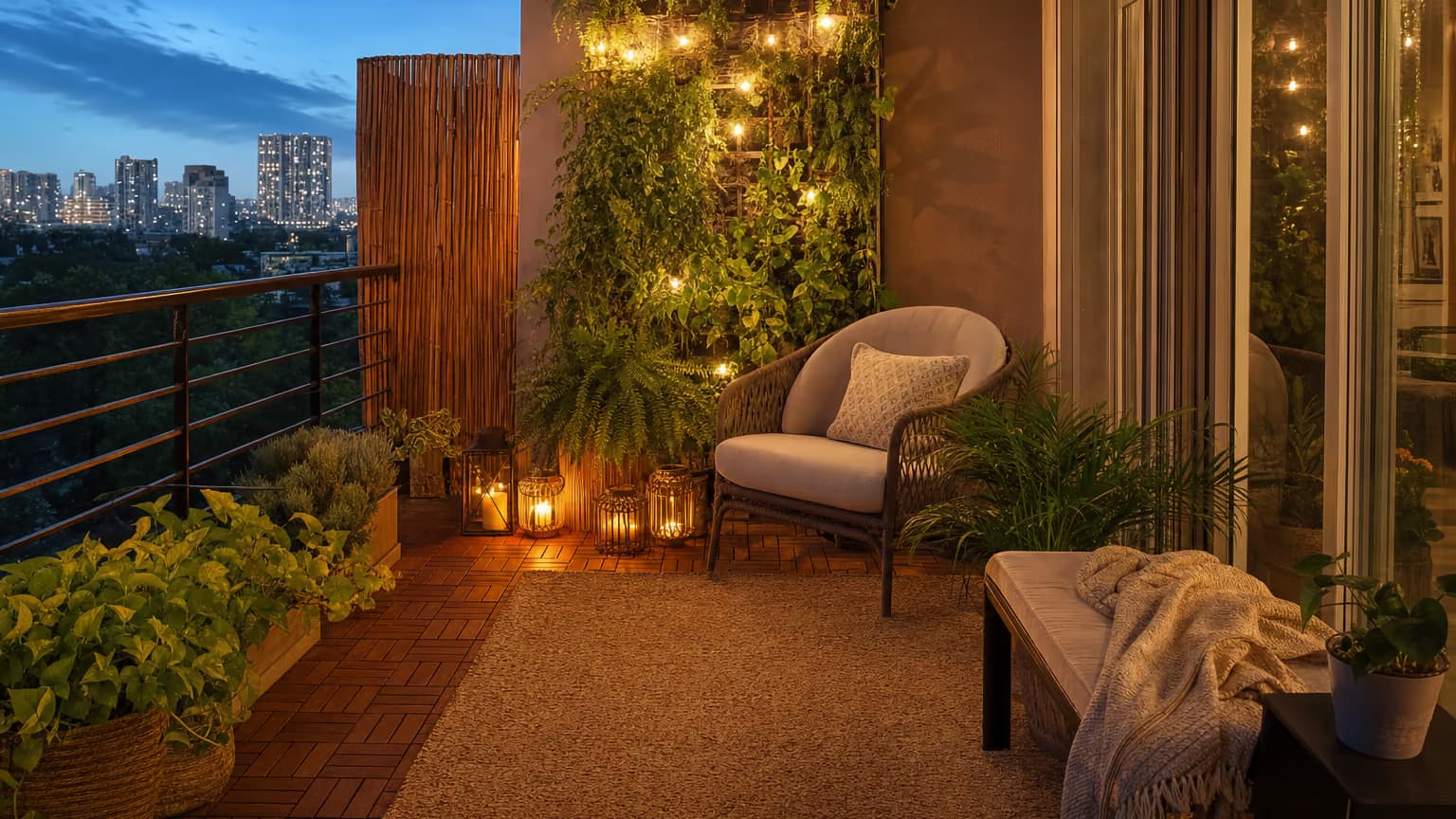
Warm string lights are the easiest way to add atmosphere. Choose warm white, around 2700K to 3000K.
Solar lanterns need no wiring, but they need direct sun to charge. On a north-facing or deeply covered balcony they will be dim by mid-evening.
Wall lights give steadier light for reading. Mount them to the side of the seat rather than overhead to avoid glare.
Every fitting outside should be outdoor-rated. As a rule of thumb, look for IP44 or higher on a covered balcony, which protects against splashing, and IP65 or higher where rain reaches the fitting directly. Use a weatherproof socket, and have an electrician do any new wiring.
Layer 5: textiles
Cushions and throws add colour and comfort, and they are the first things to fail outdoors. Outdoor cushions should use quick-dry foam, which is open-cell so water drains through, and UV-resistant solution-dyed fabric, where the colour runs through the fibre instead of being printed on top. Use quick-drying synthetic throws outside and bring cotton or wool ones in at night. In the monsoon, keep a dry spot indoors for the cushions you like most.
Layer 6: seating, the anchor
Seating is what everything else arranges around, and it sits outside through sun and rain for years. It should be built for that: a powder-coated aluminium or grade-A teak frame, a weave in synthetic wicker or handwoven rope, and quick-dry cushions.
For most flats, one good chair and a side table do more than a full set. A lounge chair such as the Arbour single lounge chair suits tea and reading, and a single seater like the Fern single seater chair is another option for one person. Put a small table beside it, such as the Fern side table, so your cup is not on the floor. If the balcony is for meals, two dining chairs such as the Perennial dining chair at a small table make more sense than lounge seating.
Swings are a favourite on Indian balconies, and we also build outdoor swings on request. A hanging swing needs a ceiling that can take the load, so check with a structural engineer and your society before anyone drills into the slab.
Long narrow balcony design ideas
Long narrow balconies are common in Indian apartments, often running past two rooms with a depth of only 3 to 4 ft. Instead of treating one as a single strip, break it into two or three zones.
Put the seating at one end, where it is least in the way of the doors. Keep the middle as a walkway and dress it with wall planters or a vertical garden rather than floor pots. Use the far end for a cluster of larger plants or a tall screen that gives the length a visual end point.
As a rule of thumb, keep a clear path of about 2 ft along the full length so you can reach both doors and the railing. Lay deck tiles lengthways and run string lights along the long wall; both make the space read as a room rather than a corridor.
Standard furniture is often too deep for these balconies. Because every piece we make is made to order, we can build seating to the exact dimensions a narrow or L-shaped balcony allows.
Large balcony design ideas
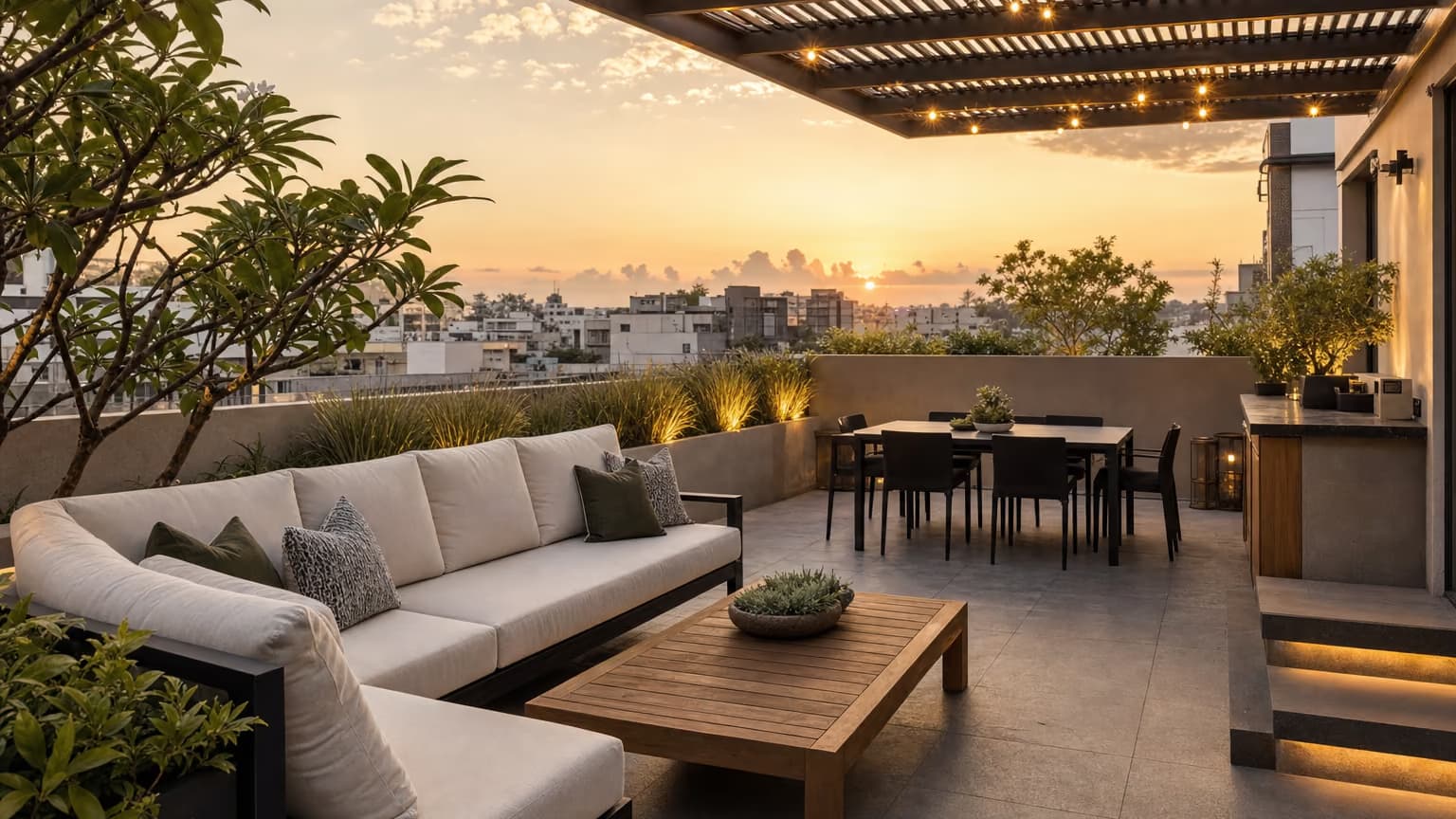
A large balcony has the opposite problem: it can take a lot, so it often gets too much. The fix is zoning. Choose two areas, such as seating and plants, or dining and a lounge corner, and separate them with a rug, a change in flooring or a line of tall planters.
A large balcony can carry one statement piece. A round daybed such as the Perennial round daybed makes a lounge corner on a wide balcony, as long as there is open floor around it.
Large balconies are also more exposed at the edges, so keep textiles and the most-used seating toward the covered side and put sun-loving plants on the outer edge. If an architect, interior designer or landscape architect is planning the space, we work with them directly.
Balcony decoration ideas on a budget
Where to save. Plants are the cheapest way to change a balcony, especially from cuttings; money plant, pothos and succulents root easily. Paint is cheap. DIY decor such as painted terracotta pots or a simple planter shelf costs very little. Solar lanterns and warm string lights cost far less than wired fittings, and an outdoor rug is the lowest-cost floor change.
Where not to save. The seating that stays outside. A painted steel frame, indoor foam or natural cane looks fine for a month and fails in the first monsoon, and then you buy it again. One well-built chair is better value than three that need replacing.
Outdoor furniture pricing depends on dimensions, materials and configuration; our outdoor furniture price guide explains what drives it.
Balcony type at a glance
| Balcony type or use | Key moves | What to avoid |
|---|---|---|
| Small balcony | One chair and side table, wall planters, string lights | Floor pots in the walkway |
| Long narrow balcony | Two or three zones, 2 ft clear path, tiles laid lengthways | One long line of pots, furniture too deep for the space |
| Large balcony | Zones divided by rugs or planters, one statement piece | Filling every corner, textiles on the exposed edge |
| Sunny (south or west facing) | Sun-loving plants, shade blinds, UV-resistant fabric | Shade plants, indoor fabrics |
| Shaded (north facing or covered) | Low-light plants, wired lighting, quick-dry cushions | Solar lanterns, flowering sun plants |
| Overlooked flat | Mesh blinds, bamboo chiks, slatted screens | Solid screens that block airflow |
Before you start: a checklist
Drainage. Find the floor drain and the slope. Nothing should block it, and saucers should stop water running onto the flat below.
Weight. Balconies are designed for people and furniture, not large beds of wet soil. Use lightweight mix in fibreglass or plastic pots, and put the heaviest planters against the main wall rather than at the outer edge. For a large planter bed or water feature, ask a structural engineer first.
Society rules. Many societies have rules on railing planters, changes to grills, invisible grills, awnings and anything visible from outside. Ask before you drill.
Monsoon cover. Decide how the balcony will handle the rains before choosing textiles: roll-down PVC blinds, a retractable awning, or a dry place indoors for cushions. In heavy-rain cities this matters most; our Mumbai page covers the coastal side.
Power. Find the nearest outdoor-safe socket, or plan for solar.
For furniture ideas by space size, see our balcony and terrace furniture ideas.
Final Thought
A balcony makeover does not need a big budget or a full set of furniture. It needs a clear idea of what the space is for, and the patience to do the layers in order: floor, walls, plants, light, textiles, and then the seat you will actually sit in.
Do the practical checks first. Drainage, weight, society rules and a plan for the monsoon decide whether the balcony still looks good a year later.
When you are ready for the seating, we make every piece to order in our Noida workshop, sized to your balcony, including narrow and L-shaped ones, and we deliver and install across India. Browse the collections, message us on WhatsApp with your balcony dimensions, or book an appointment to visit the design studio in Noida.
Frequently Asked Questions
Decide what you will use the balcony for, then work in layers. Change the floor with deck tiles or an outdoor rug, add plants chosen for the sun your balcony gets, put in warm string lights or a wall light, and finish with one comfortable chair and a side table. Keep the walkway clear and the drain uncovered. A balcony looks best when it is used, so plan it around a real daily habit.
Spend on plants, paint and lighting, which are cheap and change a balcony the most. Grow money plant, pothos or succulents from cuttings, use an outdoor rug instead of deck tiles, and choose solar lanterns or warm string lights. Do not save on the seating that stays outside, because cheap frames and indoor foam fail in the first monsoon and cost more once you replace them.
Good balcony design ideas include interlocking deck tiles over plain flooring, a vertical garden on one wall, bamboo chiks or mesh blinds for privacy, warm string lights, and a single statement chair with a side table. On a long narrow balcony, divide the length into zones. On a large balcony, separate a seating area from a plant area with a rug or a line of tall planters.
You can put weather-built seating, a small side or dining table, planters, a vertical garden, deck tiles or an outdoor rug, outdoor-rated lights and quick-dry cushions on a balcony. Avoid indoor furniture, cotton rugs, indoor electrics and very heavy soil-filled planters. Check your society rules before fixing anything to the railing or grill, and keep the floor drain clear at all times.
Break the length into two or three zones instead of treating it as one strip. Put seating at one end, keep the middle as a clear walkway of about 2 ft, and use wall planters or a vertical garden instead of floor pots along the length. Lay deck tiles lengthways, run string lights along the long wall, and choose furniture shallow enough to leave the path open.
A balcony with five or more hours of direct sun, usually south or west facing, suits bougainvillea, hibiscus, adenium, portulaca, succulents, lemongrass, tulsi and curry leaf. Most kitchen herbs and flowering plants also need that much light. Use larger pots so the soil does not dry out by midday, water early in the morning or in the evening, and use a lightweight potting mix to keep the load down.